-
ABPI Website

-
Ensuring value, access & uptake of innovative medicines & vaccines, now & in the future
- Access to medicines in England
Access to medicines in England
Access to medicines in England
Patients in the UK should be able to benefit from the latest innovative medicines as quickly as possible.
This page explores the journey a medicine must take before it can reach NHS patients in England – from initial regulatory approval through to clinical and cost-effectiveness assessment.
These graphics are designed to provide you with a clearer understanding of why regulatory approval alone does not guarantee patient access, how access rates differ between cancer and non-cancer medicines, and what the current system means for patients, including those with conditions such as blood cancers, where challenges remain.
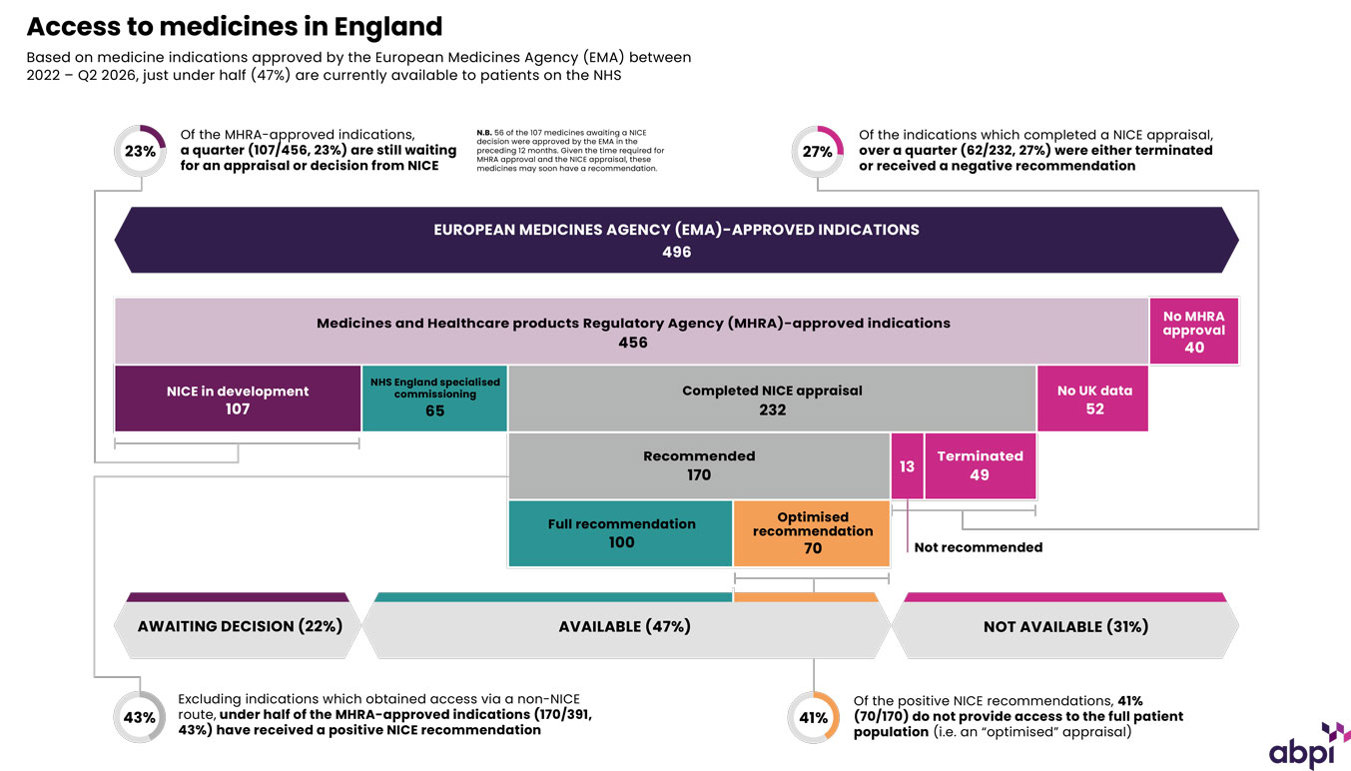
Before medicines can be used to treat patients in the UK, they must be licensed by the UK’s medicine regulator, the Medicines and Healthcare Regulatory Agency (MHRA).
After that, medicines must also be assessed to ensure they are a clinically and cost-effective use of NHS resources. In England, the National Institute for Health and Care Excellence (NICE) carries out this assessment.
Northern Ireland and Wales broadly follow NICE guidance*, while in Scotland, the Scottish Medicines Consortium (SMC) does the assessment. The graphic starts by showing all the different uses (“indications”) of medicines approved by Europe’s regulator (the European Medicines Agency [EMA]) in the specified timeframe, then looks at whether these indications have made it through the system in England to become available to NHS patients.
The aim is to provide a picture of access to medicines in England vs those licenced for use in Europe.
The graphic shows how many indications of medicines have:
been approved by the MHRA
completed a NICE appraisal
been recommended for use, both for all potential patients and for a subset (known as an ‘optimised’ recommendation)
are not yet, or may never be, available on the NHS
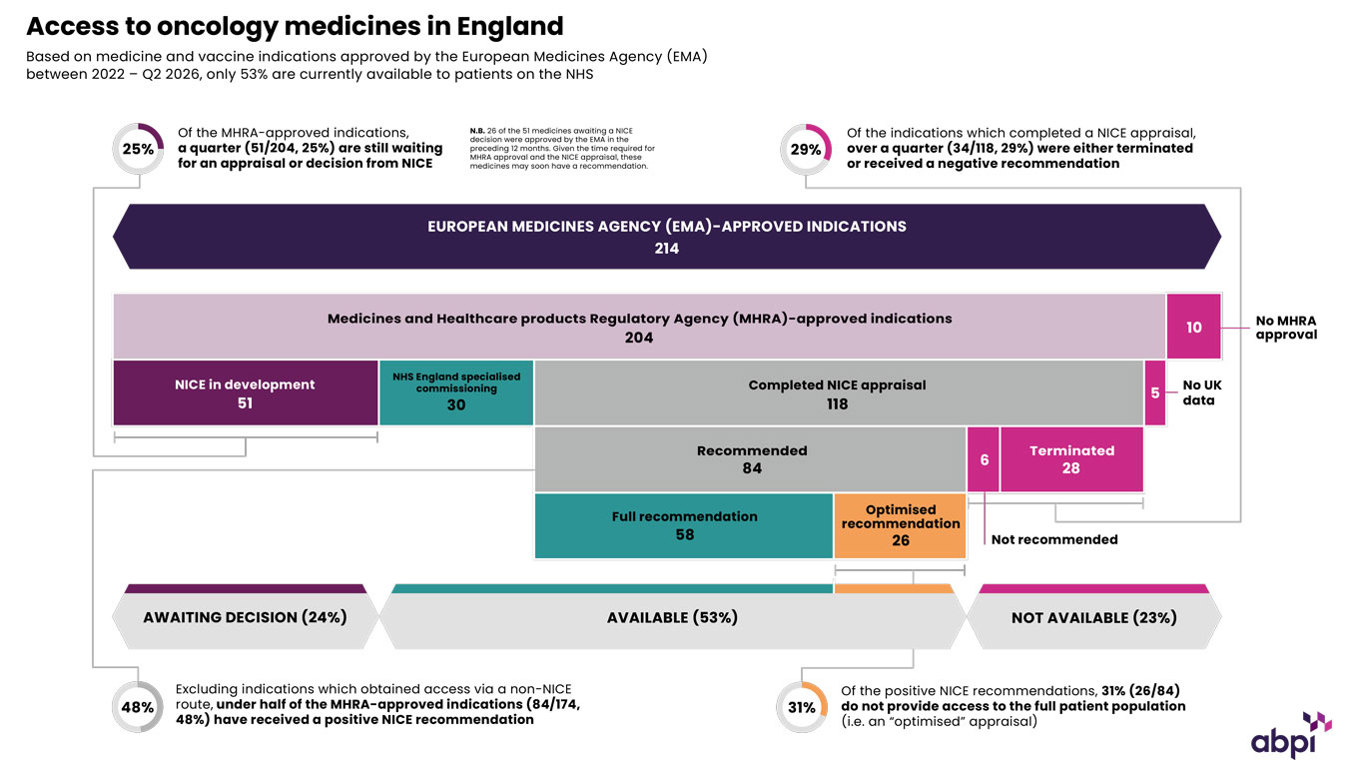
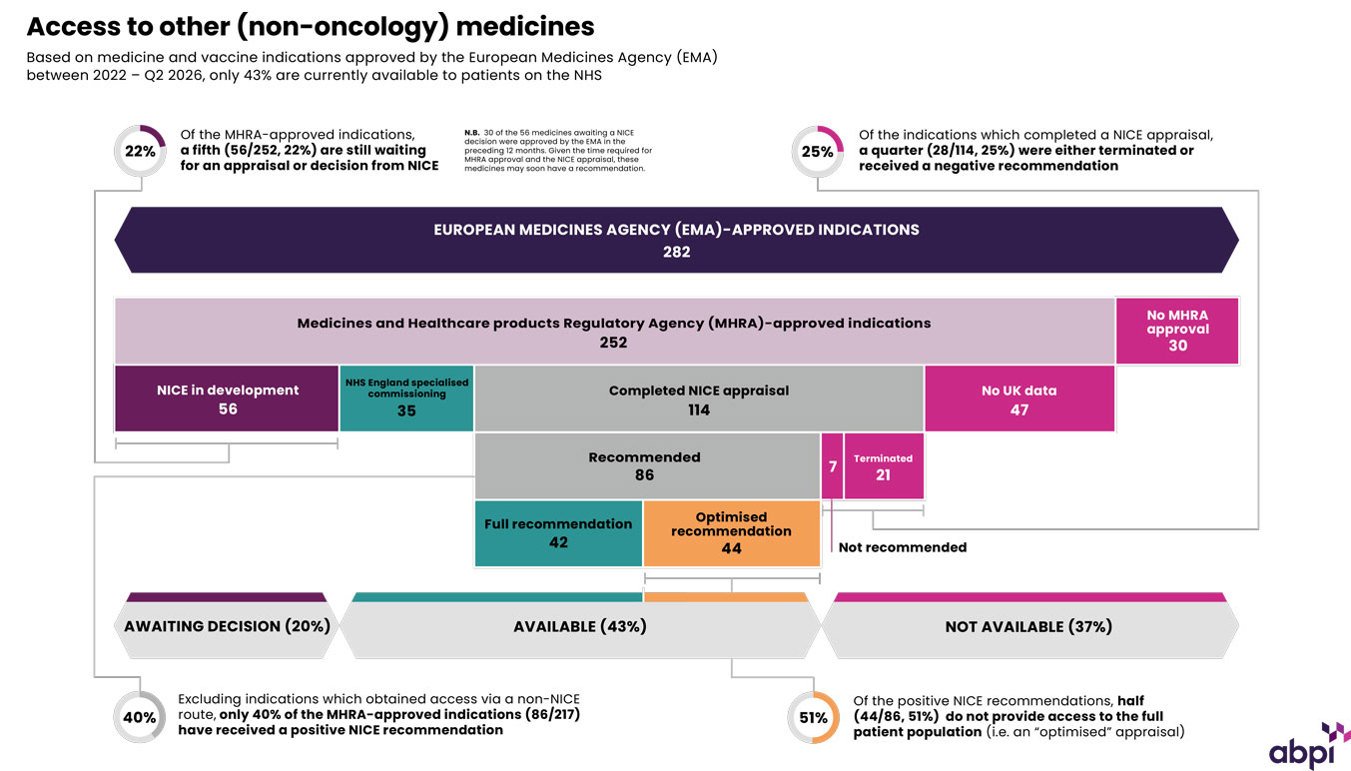
The graphic is also available for cancer (oncology) medicines only and non-oncology medicines only, to present any differences in access rates across disease areas.
EMA approvals represent only a proportion of global medicine approvals. If the graphic considered all indications for all medicines approved worldwide, including those in larger countries and regulated by agencies such as the US Food and Drug Administration (FDA), the proportion available to patients on the NHS in England would be even smaller.
Access to cancer medicines in England
What does this mean for patients?
Case study: Blood cancers
Blood cancers affect the blood and the immune system, often leaving people feeling extremely tired and more vulnerable to infections. This can have a significant impact on the quality of life of patients and their families.
"With few surgical options available, blood cancer patients are dependent on innovation in medicines to improve their outcomes and quality of life" – Blood Cancer Alliance
Despite the clear need for effective blood cancer medicines, data shows that blood cancer medicines face particular challenges in the NICE appraisal process: appraisals are more likely to be terminated than medicines for other cancer types or disease areas. Challenges arise as many blood cancer medicines are given in combination with other medicines ("combination regimens"), which improves patient outcomes however leads to difficulties in assessing cost-effectiveness using NICE's current methods.
"The disproportionate rate of terminated appraisals of blood cancer treatment suggests there are issues within the system that must be urgently addressed to ensure all NHS patients can access the best possible treatment for their disease." – Blood Cancer Alliance
Ref: Blood Cancer Alliance. https://www.bloodcanceralliance.org/access
Access to other (non-cancer) medicines in England
What does this mean for patients?
Case study: Generalised myasthenia gravis
Generalised myasthenia gravis (gMG) is a rare autoimmune condition that causes muscle weakness, which makes everyday activities such as walking, eating, speaking and breathing difficult. Symptoms can be debilitating, and in severe cases life-threatening.
Until 2026, no new medicine for gMG had been made available in England for over a decade. The NICE approval of a new medicine for gMG in May 2026 was a welcome step forwards, however several other innovative medicines which could help treat gMG are still not available in England. Medicines for rare diseases like gMG face many challenges in the NICE process, particularly those which meaningfully improve quality of life, reduce symptoms or slow progression, but may not significantly affect survival. In particular, when there is no established standard of care, innovative medicines are compared against low-cost symptomatic treatments which makes it challenging to meet NICE's cost-effectiveness thresholds. Additionally, if the medicine is already approved for a different condition, this may make it more difficult to reach NICE's cost-effectiveness requirements as less flexibility is permitted once an earlier indication is already approved.
"For people living with myasthenia gravis, finding the treatment that works for them can be life-changing, particularly when existing options fail or cause significant side effects. The first targeted therapy is a long overdue step forward – but with others already developed and struggling to get through the system, it is clear the process is not working as it should for patients." – Muscular Dystrophy UK
Understanding the graphic
Terminology used
EMA-approved indications = All indications approved by Europe’s regulator (EMA) in the specified timeframe, excluding minor extensions such as small changes to age ranges or patient weight limits.
MHRA-approved indications = All indications from the EMA list which are also approved by the UK’s regulator (MHRA).
No MHRA approval = Indications which have a licence from the EMA for use in Europe, however, do not have a licence from the MHRA for use in the UK
NICE in development = Indications that are awaiting assessment or are in development by NICE as of the end of the specified timeframe.
Non-NICE access, including specialised commissioning = Indications available in England through funding routes outside the usual NICE process, including NHS England specialised commissioning
Completed NICE appraisal = Indications that have been considered by NICE.
No UK data = Includes indications which have been approved by the MHRA, but have not been assessed by NICE and show evidence of active assessment by NICE, and show no evidence of any UK sales. On that basis, these indications are assumed not to be available to NHS patients, with no future plans to make them available.
Recommended for use on the NHS = Indications that NICE recommended for use on the NHS, either in full or for a narrower group of patients.
Not recommended = Indications that NICE decided not to recommend for use on the NHS.
Terminated = Indications where the NICE appraisal was stopped before a final recommendation was made or no submission was made by the company.
Full recommendation = Indications recommended by NICE for use in line with the full marketing authorisation.
Optimised = Indications recommended by NICE for only part of the licensed patient population.
Footnotes:
Indications are the different diseases or groups of patients within a disease which a medicine can be used for. Different indications for a medicine tend to be approved at different times, hence the graphic above considers the data on an indication, rather than medicine level, to provide as detailed a picture as possible.
*The graphic assesses approvals by NICE and therefore focuses on access to medicines in England. For a medicine to be available in Scotland, it must be approved by the Scottish Medicines Consortium (SMC). For a medicine to be available in Wales and Northern Ireland, often a NICE recommendation suffices, however the All-Wales Medicines Strategy Group (AWMSG) also carry out their own appraisals on certain medicines that NICE has not evaluated.
ABPI worked in collaboration with the Office of Health Economics (OHE) to extract the data for the infographics, via the OHE Medicines Tracker.
Last reviewed date: 21 September 2026
Next review date: 21 September 2029