- Executive Summary
- Introduction
- Pre-clinical models in medicine development
- Types of human relevant in vitro models
- The UK translational research environment
- UK pre-clinical in vitro model development
- Translational readiness
- UK strengths, gaps, and barriers
- Gaps in key materials and components
- Scientific and technical limitations
- Gaps in infrastructure
- Global landscape
- Conclusion
- Glossary of terms
- Executive Summary
- Introduction
- Pre-clinical models in medicine development
- Types of human relevant in vitro models
- The UK translational research environment
- UK pre-clinical in vitro model development
- Translational readiness
- UK strengths, gaps, and barriers
- Gaps in key materials and components
- Scientific and technical limitations
- Gaps in infrastructure
- Global landscape
- Conclusion
- Glossary of terms
Executive Summary
Pre-clinical models are biological systems designed to replicate human biology and can be in vivo (animal models), in vitro (cell and tissue based models) and in silico (computer based models). They are used throughout the medicines development process to understand human biology, identify novel targets for medicines, and test potential therapeutic candidates. Data generated from pre-clinical models is used by pharmaceutical companies to determine which therapeutic candidates to progress to human clinical trials. Poorly predictive pre-clinical models are a major driver of attrition in medicines development. Human relevant in vitro and in silico models offer the potential to improve predictivity, reduce animal use, and accelerate and de-risk medicines development.
This landscape review examines the UK academic ecosystem for human relevant pre-clinical models and evaluates how ready those models are for adoption in pharmaceutical research. A translational readiness framework (TRF) was developed with industry scientists to assesses model development, performance and amenability to industry transfer. The framework was then applied to assess a subset of UK academic models to benchmark their readiness for deployment in pharmaceutical research and development (R&D). This was complemented by stakeholder interviews with 30 senior scientists from across academia and industry.
This review identified a gap in maturity of in vitro pre-clinical models developed in academic settings compared to the translational readiness required for a model to be used in industry for medicines development. Fundamental shortcomings in robustness, validation, standardisation and scalability mean that most models require further development before routine use in industry or regulatory contexts.
1. Materials and biological inputs
Cell sourcing and characterisation. Limited availability of well characterised, quality controlled cell sources; choices often driven by availability rather than fitness for purpose.
Stem cell expertise and maturity. Technical challenges in differentiation/maturation of induced pluripotent stem cell (iPSC) derived cells (immaturity undermines physiological relevance).
Standardisation of patient derived samples. Variable collection, processing and storage practices reduce reproducibility and comparability. Consent processes and commercial use permissions are inconsistently applied.
Linked clinical data. Fragmented ability to connect biological samples with associated clinical data across biobanks limits stratification and validation.
2. Scientific and technical limitations
Lack of standardisation. No sector wide ‘gold standards’ or harmonised protocols for many in vitro systems; inconsistent endpoints and assay conditions hinder comparison.
Physiological complexity. Key biological features remain difficult to model reliably – notably functional vasculature and robust blood brain barrier systems.
Tissue microenvironment and multi organ modelling. Challenges integrating extracellular matrices, mechanical cues and multi tissue interactions constrain systemic modelling of medicine effects.
Confidence and regulatory acceptance. Limited comparative data versus pre-clinical/clinical datasets reduces confidence among industry and regulators.
Regulatory landscape. International regulators show growing interest, but regulatory qualification and acceptance for in vitro approaches remain limited and require clear validation and context of use definitions.
3. Infrastructure, funding and skills
Translational pull-through. There is limited support for models developed in academia to be further developed for their use in pharmaceutical research.
Biobank resourcing. High costs of storing samples and managing linked data are bottlenecks for national biobanking capacity.
Fragmentation and lack of connectivity. Expertise is geographically and institutionally siloed, limiting coordinated development and standardisation.
Skills gap. There is inadequate distributed training in stem cell techniques, bioengineering, multi modal assay development and data analytics needed to translate complex models.
To address these gaps and limitations and advance pre-clinical model development, coordinated investment in infrastructure, standardisation and biobanking capacity is essential. The 2025 Life Sciences Sector Plan (LSSP) announced the establishment of a pre-clinical translational models hub, bringing together cutting-edge human disease modelling capabilities and essential data. The hub provides a unique opportunity for the UK to facilitate collaboration between industry and academia, closing the translational readiness gap and making the UK a global leader in pre-clinical model development.
The government’s roadmap for phasing out animal testing commits to establishing a UK Centre for Validation of Alternative Methods (UKCVAM) to streamline processes for bringing forward alternative pre-clinical models for use in regulatory testing. This centre will play an important role in defining clear qualification pathways and context of use standards, while concurrent investment in workforce development and cross disciplinary training will broaden technical capacity in stem cell biology, bioengineering and computational integration.
The UK possesses exceptional scientific strengths and assets to lead in human relevant pre-clinical model development. However, strategic, coordinated investment in standardisation, materials, validation, infrastructure and skills will be necessary to translate the many promising models into sufficiently robust resources that can reliably be used by industry. Addressing the translational readiness gaps outlined in this review will better pull-through outputs of academic research, reduce attrition in medicines development and strengthen the competitiveness of the UK through a concerted cross-sector strategic approach to development of pre-clinical models.
The Association of the British Pharmaceutical Industry (ABPI) commissioned the National Centre for the Replacement, Refinement and Reduction of Animals in Research (NC3Rs) to produce this landscape report. The scope and purpose of the report are to examine the landscape of pre-clinical model development in the UK, focusing on academic pre-competitive models and their ability to be transferred for use by industry in developing new medicines and vaccines. Pharmaceutical companies are also making significant investments in pre-clinical models, but these were considered out of scope for this review, due to commercial confidentiality.
Recommendations in the report are based on findings by the NC3Rs and ABPI members’ views.
Introduction
Pre-clinical models are biological systems that use cell cultures, computer modelling, or laboratory animals to replicate aspects of human biology. They are used across the entire medicine development pipeline to help understand biology and disease mechanisms, identify and validate drug targets, and assess the safety and efficacy of medicines before clinical trials. To be effective, pre-clinical models must accurately mimic human physiology and disease and demonstrate that responses to treatments closely resemble those seen in humans.
Pre-clinical models can be in vivo (animal models), in vitro (laboratory-based models) or in silico (computer-based models). In vitro and in silico models are designed based on human biology, sometimes using human biological components such as patient cells, to have increased human relevance. They have the potential to be highly predictive while also reducing the number of animals used in medical research.
One of the major drivers of attrition in medicines development is poorly predictive pre-clinical models that fail to replicate human biology and disease mechanisms effectively. As a result, more than a quarter of medicines that enter clinical development fail because the effects shown in pre-clinical models do not translate into humans, termed the ‘translational gap’. 1 Developing better pre-clinical models and increasing the ease with which researchers and companies can access them provides an opportunity to improve the efficiency of medicines development, attract inward investment from global pharmaceutical companies and position the UK at the forefront of pre-clinical research.
Developing more predictive in vitro pre-clinical models is a priority for the pharmaceutical industry. In 2024, the ABPI developed a proposal to establish a pre-clinical translational models hub in the UK for industry and academic scientists to collaborate in development and scaling of in vitro models for use in medicines development. This hub has become a central focus of the government’s translational research commitments within the Life Sciences Sector Plan (LSSP), which recognises the UK’s “potential to be a world leader in applied science”. The LSSP outlines targeted investment in establishment of a pre-clinical translational models hub, aligned with the ABPI’s proposal, alongside establishment of translational research networks to harness the full strength of UK science and accelerate medicines development.
The government’s strategy ‘Replacing animals in science: A strategy to support the development, validation and uptake of alternative technologies’, published in 2025, highlights development of in vitro and in silico models as a priority. The strategy announced further commitments in pre-clinical model development through the establishment of UKCVAM to support validation and regulatory acceptance of pre-clinical models.
To guide future investment, it is essential to have a clear understanding of the UK’s pre-competitive landscape in pre-clinical model development, its position within the global landscape and how existing infrastructure can be leveraged. Using a combination of desk-based research and consultation with experts, the UK research landscape in human-relevant in vitro pre-clinical models was reviewed.
The review covered:
- an overview of academic human-relevant in vitro pre-clinical models and the current UK infrastructure supporting their development
- application of a new TRF to provide a representative snapshot assessment of human-relevant in vitro pre-clinical models currently being developed in UK pre-competitive academic laboratories and their readiness for translation to industry
- an overview of the UK technical and scientific capabilities in human-relevant in vitro pre-clinical models, highlighting areas where there is opportunity to accelerate their impact
- an overview of the global landscape in human-relevant in vitro pre-clinical model investment.
1 Nelson MR, Tipney H et al. ‘The support of human genetic evidence for approved drug indications’, Nature Genetics 47(8), 856–60, 2015
Pre-clinical models in medicine development
The medicines development process spans from discovery and translational research to pre-clinical development before entering human clinical trials, and in vitro, in silico and in vivo pre-clinical models can be used throughout the process. Medicines discovery includes early research, such as identifying potential therapeutic targets and using a combination of different model types to understand the target’s behaviour and role in disease. Once a target has been identified and its role in human biology and disease is understood, potential therapeutic candidates will be developed. A process of candidate selection and optimisation studies then commences using a range of in silico, in vitro and in vivo models to identify and improve the most promising candidates. Selected therapeutic candidates then enter pre-clinical development, where a combination of in silico, in vitro and in vivo studies are conducted to check safety, effectiveness, metabolism and toxicity before moving to first-in-human trials.
During pre-clinical development of a candidate, pharmaceutical companies must undertake regulatory testing. This includes conducting a range of tests to demonstrate that a potential therapeutic candidate is safe and effective before the regulator will grant approval to progress to human clinical trials. In the UK, approval for human clinical trials is regulated by the Medicines and Healthcare products Regulatory Agency (MHRA). Data generated using pre-clinical models will be submitted by pharmaceutical companies to the MHRA for approval to subsequently test in human clinical trials in the UK. The MHRA will only accept data from validated pre-clinical models. Data from animal studies is usually required to demonstrate a therapeutic candidate is safe in a living animal before it can be tested in humans. Therefore, if non-animal preclinical models are to be used for regulatory testing, it is essential that they are validated for acceptance by the MHRA and other regulators.
The type of pre-clinical model used depends on the defined context of use in medicine development and the stage in the R&D pipeline. Typically, earlier in the pipeline, a large number of potential therapeutic candidates are tested, which involves the use of high throughput, lower complexity models (for example, in silico and simple 2D in vitro models). Later in the pipeline, pharmaceutical companies will have triaged potential therapeutic candidates to a smaller number, which are tested using lower throughput, more physiologically complex models (for example, complex organoid in vitro models). This shift between throughput and complexity is summarised in Figure 1.
Figure 1: A schematic on the balance of model complexity and throughput across the medicine development pipeline
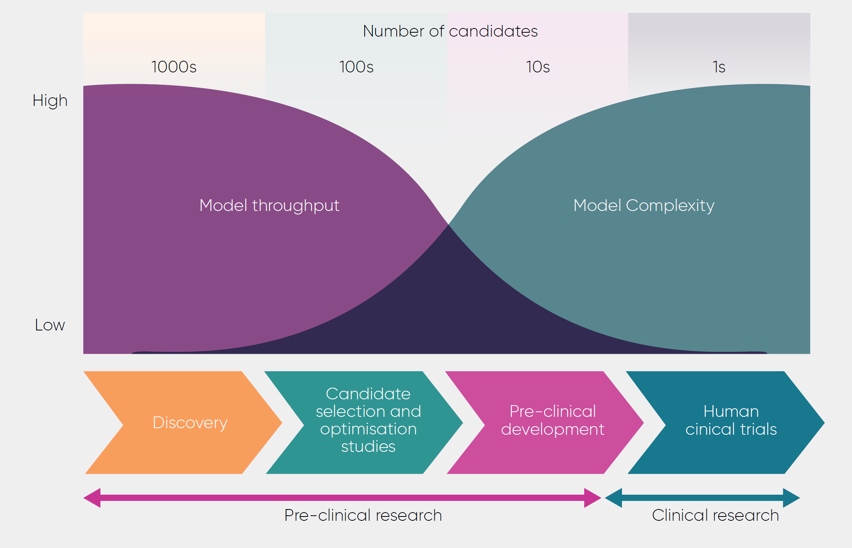
Discovery (early) research: Testing thousands of potential candidates so pre-clinical models used will typically have high throughput and scalability, but lower complexity.
Candidate selection and optimisation studies: Testing many potential candidates. Pre-clinical models will typically still have higher throughput and scalability, but they may start to increase in complexity compared to those used in discovery.
Pre-clinical development: Testing a small number of potential candidates. Preclinical models will typically be low throughput and scalability, but with high model complexity.
Human clinical trials: Typically, only one candidate which shows promise during pre-clinical development, will be progressed to clinical trials where it will be testing in human during Phase1
Data generated from varying combinations of pre-clinical models are used to make key scientific and strategic decisions about which potential therapeutic candidates should be progressed through the medicines development process and which should not. If the preclinical model used is not accurately predicting what happens in human, a therapeutic candidate may be progressed that may not be effective or safe for humans. As a result, considerable time, resources and investment will have been spent on a therapeutic candidate that subsequently may fail in human clinical trials. Improving predictiveness of pre-clinical models would improve the efficiency of medicines development by providing more human-relevant data to inform these early decisions.
There is significant potential for the growing capabilities in in vitro and in silico human-relevant pre-clinical models to impact across the whole of this process, decreasing attrition due to lack of translation, replacing animal use and facilitating a more efficient pipeline of medicines. Many in vitro and in silico models are already being used internally for company decision-making, however regulatory adoption remains limited and requires formal qualification and acceptance by a medicines regulator for defined contexts of use.
Additionally, the therapeutic modality landscape has evolved beyond small molecules to include medicines such as monoclonal and bispecific antibodies, oligonucleotides, peptides, mRNA vaccines and cell and gene therapies. These modalities often have higher target specificity than small-molecule medicines and provide access to targets previously considered ‘undruggable’ using classical small molecules. Existing pre-clinical animal models may provide limited translatability when evaluating these new modalities due to the human-specificity of the targets, driving the need for the development of more alternative robust human-relevant pre-clinical models. Therefore, in addition to improving the efficiency of small-molecule medicines development, more predictive non-animal, preclinical models may have an added benefit of improved translational relevance for these newer medicine modalities.
Types of human relevant in vitro models
Human cell-based in vitro models range from traditional 2D cell cultures through to advanced 3D systems such organoids and organ-on-a-chip technologies. Advanced in vitro models provide more predictive and physiologically relevant models of human tissue than traditional 2D cultures to study disease mechanisms, identify new targets and test drug efficacy and safety in patient-specific cells and tissues. Additionally, access to patient-derived samples and iPSCs is enabling modelling of patient-specific biology and disease in vitro, supporting the development of personalised medicine approaches. The key model types and advantages and limitations for using these in the medicines discovery process are shown in Table 1.
Table 1: Types of in vitro model used in drug discovery
| Model | Description | Advantages | Limitations |
|---|---|---|---|
| 2D culture | Simple cell cultures that involve the use of cells grown in a 2D monolayer. Usually immortalised cell lines but may utilise samples from patients. |
Simple and accessible Low cost High throughput High reproducibility |
Lack of physiological relevance Cannot model interactions between different cell types Poor prediction of in vivo responses |
| 3D culture | Cells are grown in 3D structures, such as scaffolds, spheroids, or gels. |
Improved physiological relevance compared to 2D cultures Can model cell-cell and cell-extracellular matrix interactions |
Limited vascularisation Reproducibility issues Simplified tissue complexity Higher cost and technical complexity compared to 2D models |
| Organoids | Complex cultures of cells derived from tissues or stem cells with the capacity to self-assemble and replicate organ-specific pathophysiology. |
Personalised medicine application - can be grown from patient-specific cells Long-term culture enables their use for development and regeneration studies. High structural and functional complexity |
Absence of vasculature High heterogeneity with batch-to-batch variability Limited lifespan and size Complex and time-consuming protocols |
| Organ-on-chips | Micro-engineered devices that mimic the structure and function of human organs by combining living cells with microfluidic systems. |
More realistic modelling of organ-level responses – can recreate key physiological features such as tissue interfaces, fluid flow and mechanical forces Real-time monitoring with integration of sensors for continuous functional readouts |
Low throughput and not yet suitable for large scale screening High cost Only provide partial organ representation - modelling specific parts of organ tissue rather than whole organ physiology Inability to model organ-organ interactions |
| Ex vivo tissue | Clinical samples taken directly from patients and cultured. |
High physiological relevance - Retains the anatomical structure of the tissue or organ of origin Precision cutting approaches allow multiple slices to be obtained from resected tissue which permits various experimental conditions to be tested concurrently from the same donor. |
Limited usability as tissues survive hours to days Donor variability Restricted accessibility Not suitable for long term studies Technically challenging |
This review focuses primarily on in vitro models, but it is important to note that in silico approaches are increasingly used alongside in vitro and ex vivo systems. In silico models can be used to help guide the design of more physiologically relevant models, identify meaningful biological readouts and improve experimental optimisation by simulating conditions before work is carried out in vitro. Multiscale human data-derived biophysical models can incorporate molecular interactions in the context of virtual tissues, organs and systems, providing ‘digital twins’ of complex biological systems. These can then, for example, be used to guide which patient-derived samples to use in vitro and to understand how patient heterogeneity may influence disease or treatment response, improving both the predictive power of in vitro models and their relevance to human biology.
The UK translational research environment
There have been significant technological advances in the ability to use human cells and tissues to model human biology and disease, with the development of stem cells, organoids and engineered organ-on-chip technologies delivering a step change in modelling the structure and function of human organs in vitro. The UK translational research environment is primed to support pre-clinical model development and build on these technological advances.
Academic research in the UK benefits from world-leading universities, skills and expertise spanning cellular and disease biology, engineering, chemistry, and computational approaches. This is supported by a well-established clinical research infrastructure, underpinned by the NHS, which allows sourcing of biological samples with clinical data. These are key assets to pre-clinical model development in the UK, albeit that access to samples and data for commercial organisations is variable. The UK also benefits from strong capabilities in enabling technologies for model development, such as gene editing, imaging and bioprinting. Gene editing allows for the creation of disease-relevant models by introducing or correcting mutations, advanced imaging provides real-time insights into cellular behaviour and structure, and bioprinting enables the fabrication of tissue-like architectures that mimic the organisation of human organs. The UK has strong capabilities in these areas, with CRISPR-based genetic engineering and -omics technologies frequently cited by experts as national strengths.
The UK also has world-leading research centres, including pre-clinical model development.
The Centre for Predictive in vitro Models at Queen Mary University of London is a cross-faculty interdisciplinary initiative focused on advanced in vitro models. The centre works with academics, clinicians, policymakers and industry stakeholders and has quickly become home to one of Europe’s largest organ-chip facilities.
The aim of the centre is to translate in vitro models to accelerate the discovery and delivery of safe and effective therapeutics. It leads work on functional microvasculature and circulating immune components within organ-chip technologies.
The Francis Crick Institute was founded by UK Research and Innovation Medical Research Council, Cancer Research UK,
Wellcome, University College London, Imperial College London and King’s College London. Its research spans fundamental science to technological innovation, with a strong focus on pre-clinical to clinical impact and improved understanding of disease. By combining diverse scientific expertise with external partnerships, the institute is helping to drive the development of more sophisticated and human-relevant in vitro models for disease research, medicine development and personalised medicine.
The Wellcome Sanger Institute is a world leader in genomic research and plays a key role in advancing human-relevant preclinical model development through the creation and large-scale
characterisation of organoid and cell-based models derived from patient tissues. By combining functional genomics, CRISPR-based screening and high-throughput data generation, the Sanger develops physiologically relevant models that better reflect human disease biology. These models are annotated, openly shared and used to explore disease mechanisms and drug responses.
The Milner Therapeutics Institute in Cambridge provides a key centre for academic researchers from the University of Cambridge, the Wellcome Sanger Institute and the Babraham Institute to collaborate with nine pharmaceutical companies and accelerate the development of a variety of therapies. It has themes across target discovery, AI and computational research and functional genomics.
LifeArc is a not-for-profit organisation whose central goal is to take scientific discoveries from academic laboratories and help translate them into real-world diagnostics, treatments or therapies that can reach patients. It is focused on developing medical advances in complex and rare diseases, offering collaboration and support in small-molecule drug discovery, and providing compound libraries for screening and assay development expertise.
The Medicines Discovery Catapult was established by Innovate UK in 2016 to provide expertise in medicine and model evaluation, with key strengths in neuroscience, cardiac biology, oncology and immunology, as well as a detailed understanding of the evaluation of emerging drug modalities such as RNA therapies and antibody-drug conjugates. The catapult helps to identify potential applications for models and connects pre-clinical model developers with partners, enabling them to access specialist expertise and facilities to support their translation into pharmaceutical R&D.
The UK is well positioned to be a global leader in pre-clinical model development, given its strong scientific base, world-class infrastructure, and depth of expertise. However, the current landscape is siloed, with limited strategic coordination, and existing funding mechanisms do not support sustained, translational advancement for eventual industrial use. Strengthening mechanisms for a strategic approach for academia–industry collaboration focused on pre-clinical models translation will be critical to accelerating the development, validation, and adoption of robust pre-clinical models.
UK pre-clinical in vitro model development
UK investment in human-based in vitro models over the period 2014 to 2024 was approximately £63M per year (1,704 grants). Using the Health Research Classification System categories, the seven largest categories of investments have been for in vitro models in generic health relevance, infection, cancer, neurological, inflammatory and immune system, and cardiovascular research. This represents a substantial number of models being developed in academia that may be of use to industry.
However, the model development landscape is highly fragmented. Models are being developed in different locations across the UK, each with unique features and for different intended applications. Without a centralised repository of knowledge of the research activity underway, it is difficult to assess their maturity and evaluate their suitability for industry use. Understanding the development status of pre-clinical models in academic laboratories, and any barriers preventing their use in an industrial setting, would deliver benefits to academic research, the pharmaceutical industry, the wider life sciences sector and economy.
Translational readiness of current UK pre-clinical in vitro models
There are various technical requirements needed from a pre-clinical model to demonstrate it is “industry ready” so it can be utilised in pharmaceutical research. These requirements relate to the model’s performance and ability to replicate human biology, the accessibility of the required materials, its reproducibility and robustness, and its ability to be used at scale. These factors together determine the translational readiness of the model.
A Translational Readiness Framework was developed, in collaboration with leading industry scientists, to assess how close (mature) models in academic laboratories in the UK are to being ready to be translated for pharmaceutical industry research use. This exercise was complemented by interviews with scientists from across the sector to further explore the current UK pre-clinical model landscape and to identify gaps in model development and the supporting infrastructure.
The Translational Readiness Framework is shown in Table 2. This was designed as a tool to benchmark the maturity of pre-clinical models across any context of use for their ability to be deployed in industrial pharmaceutical R&D. The Framework is independent of model type and disease area, with its focus on the performance of the model rather than its specific area of application. It is intended to be used by the pharmaceutical industry and Contract Research Organisations (CROs) to assess whether a model merits further investigation, and by academic model developers as a guide to factors that need to be considered to ensure their model can be used by industry.
Table 2: Pre-clinical model Translational Readiness Framework
| Aspect/Component | |
|---|---|
| 1. Model components required to make the model (e.g. cells/tissue/media) readily available to other users (e.g. with a secure supply chain, from tissue banks) | Model development |
| 2. Robustness and reproducibility of the model evidenced (e.g. intra- and inter-laboratory testing) | |
| 3. Methodology required to set up the model accessible (e.g. open access protocol repository or published literature) | |
| 4. Peer-reviewed literature published using the model | |
| 5. Evidence of application of the model to other research areas (for example, have you transferred your model to research groups working in other areas?) | Model performance |
| 6. The translational relevance of the model evidenced (for example, does it show meaningful biological responses such as functional or disease-related outcomes that behave as expected when tested with well-known compounds?) |
|
| 7. Data concordance with pre-clinical or clinical studies established (for example, have you compared the results from your model with data from pre-clinical or clinical studies, and do they show similar or consistent outcomes?) | |
| 8. Model used to identify new targets, toxicity information or mechanisms of disease | |
| 9. Performance level or predictivity of the model has been shown to have improved human relevance compared to existing models | |
| 10. Scalability potential of the model (for example, can the model be produced or run at a larger scale without losing quality?) | Amenability to industry transfer |
| 11. Transferability potential of the model (can the model be successfully transferred to other laboratories or organisations?) | |
| 12. Potential context of use of the model in industry/medicine development (for example, could the model be used in screening, efficacy, toxicology, safety) |
Twenty-nine academic model experts anonymously completed the TRF for human-cell based in vitro models being developed in their laboratories, answering each aspect/component with either ‘yes’, ‘no’ or ‘other’. Respondents were also given an optional free-text section to complete to provide further context to their answers. Analysis of responses was agnostic to model type and organ area to determine gaps across the sector. A summary of the responses is shown in Figure 2.
Figure 2. Summary of responses to the TRF
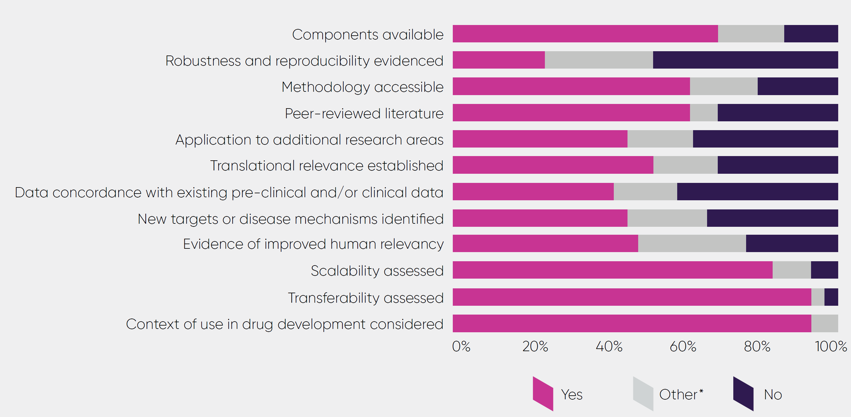 * ‘Other’ was a free text box to allow for answers that didn’t easily fit into yes or no, such as ‘this is underway’.
Responses to the TRF highlight that although most academics have considered potential uses for their models in medicines development, further work is needed before models are ready for use by industry.
Gaps identified from the responses to the TRF are:
- Robustness and reproducibility. To validate that a model sufficiently replicates a biological process, researchers must demonstrate that it will provide relatively consistent data by providing evidence of reproducibility. Only 24 per cent of respondents indicated that robustness and reproducibility of the model had been evidenced, despite this being essential for validation of the model and transferability for use in another setting. Information provided by respondents indicated that this was due to a lack of resource and funding to support such studies.
- The applicability of models to other research areas. Evidence that models can be applied beyond the original research area increases confidence in their use. However, only 44 per cent of respondents indicated that they have applied their models to other research areas, meaning the utility of the model is limited to the specific scientific question the model was developed to answer.
- The translational relevance. Evidence of translational relevance provide confidence that the model functions as it is intended to. Demonstrating translational relevance through clear translational endpoints was cited as a priority for several of the industry scientists consulted. 52 per cent of respondents reported that their models had been validated and could demonstrate translational relevance with clear functional endpoints. Where this had not been completed, additional feedback provided indicated that the work was ongoing or there was early evidence of this being assessed.
- Pre-clinical and clinical data comparisons. Comparison with existing pre-clinical and clinical data provides evidence of the model’s performance in replicating human biology. However, only 41 per cent of respondents indicated that they had compared the results from their model with data from pre-clinical or clinical studies and that they had demonstrated similar or consistent outcomes. Further information provided by respondents where this had not been done suggested that comparative studies were limited due to a lack of knowledge of, or access to, existing datasets for comparison, or a lack of available reference compounds to test the models.
- Identification of new targets or mechanisms of disease. A key part of medicines discovery is using pre-clinical models to identify new potential targets for which a medicine could be designed. Pre-clinical models that can provide novel biological information, such as identifying new targets, are needed to improve medicine development. However, only 45 per cent of respondents reported that the models had been used to identify new targets or mechanisms of disease. Where the responses were ‘no’ or ‘other’, respondents indicated that this was an area of significant interest, but that further funding was needed, or that the model was currently too early in development for this to be possible.
- Performance level or predictivity of the model. The primary purpose of a pre-clinical model being used during pre-clinical development is to be predictive of human biology. Providing evidence that new pre-clinical models perform better than existing models enables confidence in their uptake. However, only 48 per cent of respondents indicated that they had evidence that their models demonstrated improved human relevance and/or improved performance over existing models. Where the responses were ‘no’ or ‘other’, respondents indicated that these studies were planned, partially completed or needed further funding to support.
The responses to the TRF identified a clear difference between models being developed in academic settings in the UK, and the performance standards and evidence needed for a model to be used in pharmaceutical research to develop a medicine that is effective and safe for humans.
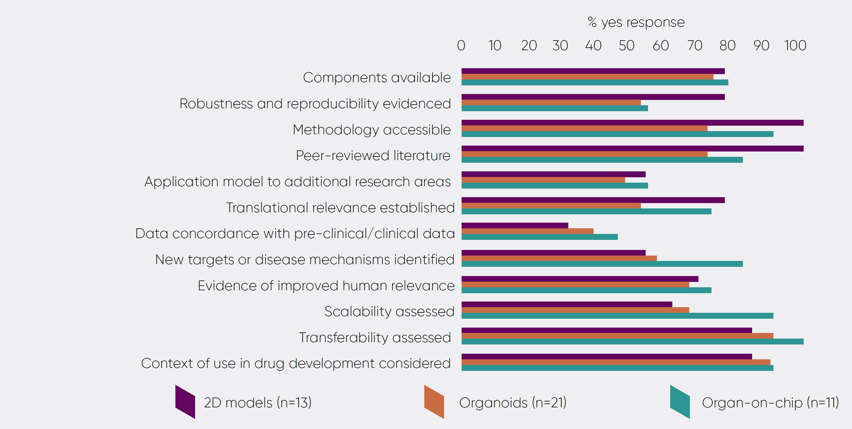
To assess whether the gaps identified were specific to certain model types or organ systems, the TRF was completed for an additional 57 models being developed in academia. These included models of the neurological system (19 models), lung (12 models), liver (12 models), gastrointestinal system (7 models), cardiovascular system (5 models), and kidney (2 models), spanning 2D cultures, 3D systems, organoids, organ-on-chip platforms and ex vivo tissue slices. Analysis by (a) organ system and (b) model type showed no difference in translational readiness by model type or organ system, suggesting the gaps identified in translational readiness were fundamental across preclinical model development. Further development is needed in all organ systems and model types before models can be effectively transferred to industry.
Figure 3A. Analysis of Translational Readiness Framework responses by organ system (N = 57)
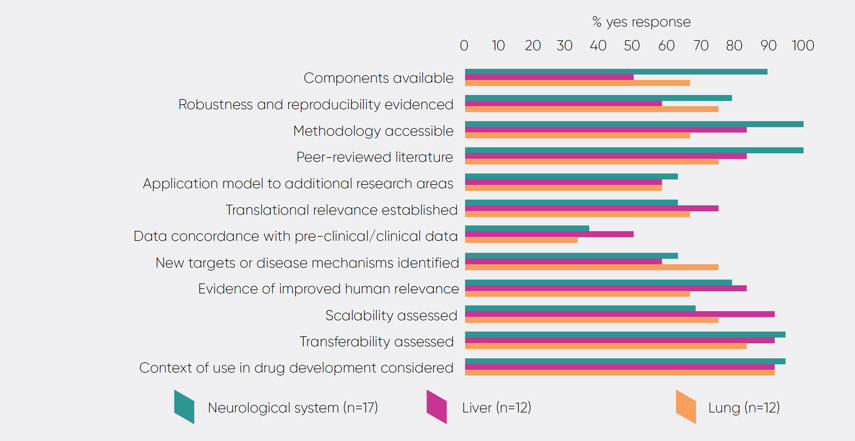
Figure 3B. Analysis of Translational Readiness Framework responses by model type (N = 57)
UK strengths, gaps, and barriers to the translation of models from academic to application in medicine development
To complement the TRF, interviews were carried out with an additional 30 senior scientists from across the pharmaceutical and academic sectors. They included academic model developers covering cardiovascular research, cell biology, neuroscience and toxicology from nine UK universities, industry experts from seven companies, and those supporting the use of pre-clinical models through the provision of cells and tissue. Interview questions explored the current status of human-relevant pre-clinical model development in the UK, the key strengths and gaps, and the barriers to translation of models from academia to application in medicine development.
Scientists from across the sector reported that collaborations between academia and industry to develop pre-clinical models are mutually beneficial. Academic researchers contribute deep biological understanding essential for building physiologically relevant models, while industry brings a translational focus and the need for reproducibility, scalability and rapid problem-solving. However, differences in timelines, goals and definitions of robustness and reproducibility often limit effective collaboration. Industry typically seeks validated, fit-for-purpose models that can be deployed immediately or optimised through targeted pilot studies, whereas academic models are often developed to answer specific biological questions.
Despite the UK’s strong expertise in pre-clinical model development, several systemic gaps are hindering the rapid adoption of new models from academia into medicine R&D. These gaps are not limited to any one model type or tissue of interest but span the model development landscape. Although these challenges are not unique to the UK, there is an opportunity for the UK to strategically address them and leverage its strengths in science and engineering to advance the development, deployment and global uptake of next-generation human-relevant pre-clinical models.
Gaps in UK pre-clinical model development identified from stakeholder interviews can be grouped into three areas: (a) gaps in key materials and components required to create more human-relevant preclinical models; (b) scientific and technical limitations for the wider adoption and translational potential of in vitro models; and (c) gaps in infrastructure to support model development and transfer to industry. The findings relating to each of these gaps are described below and summarised in the section ‘Key findings of the review’.
Gaps in key materials and components required to create more human-relevant pre-clinical models
Pre-clinical models are only as robust as the components they are built from. Researchers need access to clinical samples and data and must select the most suitable choice for their model. Patient-derived material is essential for physiological relevance but presents challenges for model standardisation and must be accompanied by the appropriate clinical data to be truly useful. Placing greater focus on improving the materials used and their availability and accessibility will ultimately improve the quality and reliability of the models developed.
- Cell sourcing and selection. In many cases, models are developed using cells based on availability and researcher expertise, rather than being the most suitable choice for the intended application. There is a lack of well-characterised, quality-controlled cell sources, with few resources providing detailed phenotypic and functional validation. Investment in basic cell characterisation is needed as a foundation for reliable, scalable model development.
- Expertise in stem cell differentiation and maturity. While stem cells, particularly iPSCs, have transformed in vitro modelling, their use remains technically demanding with specialist expertise required to maintain, differentiate and mature the cells under controlled conditions. Stem cell immaturity also remains a major biological limitation. Most tissue-derived stem cells do not fully acquire the functional characteristics of mature human cells, which can undermine their relevance for disease modelling and drug testing. While progress has been made in maturing certain cell types, such as iPSC-derived cardiomyocytes, others, like hepatocytes, remain difficult to produce and mature reliably. Developing protocols that drive functional maturity without loss of phenotype is essential to ensure these cells behave like human tissues.
- Standardisation of patient-derived samples. The incorporation of patient-derived samples into in vitro models presents challenges in standardisation. Although these samples are valuable for capturing patient heterogeneity, variability in how tissues are collected, processed and stored can compromise reproducibility and limit comparisons between studies. Developing and adopting standard operating procedures for tissue handling and data collection is critical if these models are to be used confidently. Additionally, ethical and regulatory approvals, particularly for patient consent for commercial use, must be addressed at the point of sample collection to ensure the cells can be used across the sector.
- Access to associated data. A major challenge lies in the link between biological samples and associated clinical data. Access to clinical samples through the NHS is a key strength for model development in the UK, with flagship resources such as UK Biobank providing well-annotated samples with rich associated datasets. However, the reality is that many local biobanking services lack the infrastructure or processes needed to reliably connect samples with high-quality, comprehensive clinical data. This disconnect limits the utility of patient-derived models for accurately reflecting real-world populations. Ensuring that all biobanked samples are accompanied by accessible, well-curated clinical data would enhance the use of both in vitro and in silico models by enabling researchers to stratify patient populations, track disease progression and validate outcomes more effectively.
Scientific and technical limitations for the wider adoption and translational potential of in vitro models
While significant progress has being made in model development, some key elements required for physiologically-relevant pre-clinical models remain difficult to replicate. Addressing these gaps is essential to ensure models are translationally relevant.
- Lack of standardisation. A major issue is the lack of standardisation in the design and application of in vitro models. This contrasts with in vivo models, where there are ‘gold-standard’ disease models, with well-characterised protocols (for example, using specific mouse strains and dosing regimens). Different research groups use varying cell types, media conditions or assay endpoints to study the same biological question, often making it difficult to compare results across studies or draw consistent conclusions. Greater standardisation in model design, alongside agreement on clinically relevant functional assay endpoints, would improve both the reproducibility of, and confidence in, the translational relevance of these systems.
- Physiological complexity. Two specific unmet needs in preclinical models that were widely highlighted through the stakeholder engagement as critical gaps that need addressing are in the development of vasculature and the blood-brain barrier. Most in vitro systems lack functional vasculature, limiting their physiological relevance and long-term viability. Several approaches such as endothelial-lined microfluidic channels, 3D bioprinting and angiogenic scaffolds are being explored to create perfusable vascular networks that could enable better nutrient delivery, longer culture times and more accurate modelling of systemic drug effects. Similarly, robust blood-brain barrier models remain underdeveloped despite their importance to medicines targeting the central nervous system. Improved blood-brain barrier models would enhance the prediction of drug permeability and barrier dysfunction, helping to reduce late-stage clinical failures.
- Tissue microenvironments. In addition to cells, in vitro models require other critical components to accurately replicate the biological, chemical and physical environment of human tissues to support cell function and tissue organisation. These include extracellular matrices, scaffolds, mechanical stimuli and specialised media, all of which are critical for supporting realistic cell behaviour and tissue organisation. Integrating these elements is challenging and there is a need for closer collaboration between biologists and engineers to ensure the non-cellular components of models are incorporated in a physiologically relevant way.
- Multi-organ systems. The development of in vitro models that recapitulate multi-organ systems is particularly important for the pharmaceutical industry, as these models can simulate systemic drug effects and organ-organ interactions. However, such systems remain technically challenging. They require the integration of multiple cell types with distinct culture requirements into a single platform, which makes it difficult to maintain cellular viability and function over time. While significant progress is being made, current in vitro platforms are still not able to fully replicate the biological complexity and dynamic interactions of multi-organ systems in vivo.
- Confidence. While the development of in vitro models is steadily increasing, a key barrier remaining is the confidence gap, with many of those interviewed questioning whether these models can truly replicate the insights provided by animal studies. Bridging this gap will require robust characterisation and qualification studies and the establishment of sector-wide standards for model performance, allowing meaningful comparisons and ensuring reliability. Achieving confidence in in vitro models also depends on a broader mindset shift across the sector. Academics often report difficulties publishing in high-impact journals without accompanying in vivo data and grant reviewers may question the completeness of in vitro models without parallel animal studies.
- Regulatory requirements. Many international regulations require in vivo testing for toxicology and safety assessment. While there is increasing interest from European and American regulators in the potential for greater use of in vitro models to replace in vivo models, animal testing will therefore remain an important part of the medicines development pipeline for the foreseeable future. However, there are opportunities for the regulatory landscape to facilitate greater innovation, for example, by actively encouraging submissions that incorporate data from validated in vitro models. In 2024, the ABPI, MHRA and NC3Rs hosted a joint workshop, ‘Incorporating new approach methodologies in the development of new medicines’. The workshop highlighted the importance of early regulatory engagement, clear guidance on qualification and validation and international collaboration to support the integration of human-relevant approaches, particularly in areas where traditional pre-clinical models are less predictive.
Gaps in infrastructure to support model development and transfer to industry
Despite the UK’s recognised strengths in model development, there are gaps in infrastructure that are limiting the opportunities for cross-sector collaboration and gaps in funding mechanisms to support the development and translation of models for use in industrial pre-clinical R&D.
- Limited dedicated funding for translation: There is a clear gap in translational readiness of models developed in academia that are appropriate for use in the pharmaceutical industry. This should be addressed by strategic funding to support the translation of models for pharmaceutical research by expert teams focused on bridging the gap between academia and industry. There is concern among the stakeholders interviewed that the UK lags behind the US in this regard, where there is greater infrastructure and investment for commercialising academic innovation.
- Funding for cell and tissue sources is a significant issue. The high costs associated with storing biological samples and managing linked data represent a major bottleneck for biobanks. Addressing this funding gap would help ensure that high-quality resources can be provided for model development with equitable access for all researchers.
- Lack of connectivity. There is a wealth of expertise in human-relevant pre-clinical model development spread across the UK, but its potential is not being fully realised due to a lack of connectivity, collaboration and strategic coordination. Researchers are often geographically siloed and there is limited coordination to ensure expertise is shared in a structured way. To fully capitalise on the UK’s distributed expertise, greater investment in infrastructure across the UK is needed. This is also required to better facilitate cross-disciplinary collaborations to address the current limited integration of expertise in vitro and in silico models.
- Skills gap. There is a clear need for relevant training in model development and enabling technologies to build capacity and enable broader adoption of advanced in vitro models. As new model systems emerge, they bring with them a significant demand for new technical and analytical skills, requiring integrated training to embed these skills across the sector. To address this, more centralised training initiatives – potentially coordinated through national networks or public-private partnerships – could play a key role in building the skilled workforce needed to support in vitro model development and adoption across sectors.
Responses to the TRF and stakeholder interviews highlight a strong foundation of expertise in human-relevant pre-clinical model development across the UK, while also emphasising the need for coordinated action to improve the readiness of these models for industrial application. While academic researchers are developing a wide variety of models, challenges remain in accessing well-characterised cells and tissues, standardising model design, demonstrating robustness and translational relevance, and securing the infrastructure and skills required for transfer to industry.
Global landscape in human-relevant pre-clinical models
The global importance of pre-clinical model development is increasingly being reflected by government investment internationally. The UK government has announced £60M of investments in pre-clinical model development which will be established from 2026, including the pre-clinical translational models hub in the LSSP, and the UK Centre for Validation of Alternative Methods as part of the strategy to support development validation and uptake of alternative methods. Ensuring the focus and scope of UK investment is strategically positioned in the global landscape and aligned with the UK skills, talent and expertise will ensure the maximum scientific and economic benefits are realised. Here, we focus on the USA and Europe to provide an overview of recent international investment in this growth area.
The USA
The United States has made substantial progress in promoting human-relevant pre-clinical models through strategic collaborations across government, regulatory bodies, academia, and industry. This momentum has been accelerated by the U.S. Food and Drug Administration (FDA) Modernization Acts 2.0 and 3.0, which advocate for the use of non-animal methodologies such as organ-on-a-chip in medicine development, with an initial emphasis on monoclonal antibody therapies. There are plans to establish a National Institutes of Health (NIH) Office of Research Innovation, Validation and Application to advance human-based science and harmonise validation standards for alternative methods. This would be done working closely with the Interagency Coordinating Committee on the Validation of Alternative Methods that includes representatives from 18 agencies.
United States government investment includes the recent NIH announced launch of the Standardized Organoid Modeling Center at the Frederick National Laboratory for Cancer Research. With contracts totalling $87M for the first three years, the Center’s goal will be to leverage the latest technologies to enable real-time optimisation of organoid protocols. The Center is designed to support regulators, researchers and clinicians from all sectors and will provide open access to protocols, data, and organoids. It will also work with regulatory bodies, including the U.S. FDA, to develop models that meet pre-clinical testing standards, accelerating development of new disease treatments and safety assessments. The initial focus is on organoid models of the liver, lung, heart, and intestine, with plans to expand to additional organ systems and disease-specific models. The Center will offer a combination of AI and machine learning to develop world-class organoid protocols, advanced robotics for large-scale production, and open access repositories for physical samples and digital resources. This new infrastructure builds on previous investment in this area, including the Complement-ARIE programme, which has a reported ten-year budget of $390M to catalyse the development, standardisation, validation and use of human-based models across basic, translational and clinical sciences focusing on in vitro, in silico and in chemico approaches. Additionally, the US National Center for Advancing Translational Science supports an extensive tissue-chip programme for drug safety, efficacy, and precision medicine. It has partnered with the U.S. FDA to establish four Translational Centers focused on the adoption and use of tissue-chip technologies and their qualification within a defined context of use.
The USA is also home to some of the major world-leading organisations in human-relevant pre-clinical model development. This includes the Gladstones, Broad and Wyss Institutes. The latter, which is based at Harvard University, is focused on disruptive innovation with eight enabling platforms including Living Cellular Devices and 3D Organ Engineering. Long-seen as pioneers of organ-on-a-chip technologies, the Wyss Institute has demonstrated the value of cross-disciplinary research both in their technology advances and through the creation of one of the world’s most successful organ-on-a-chip companies, Emulate.
Europe
The European Commission and national governments have funded human-relevant pre-clinical model projects, enabling collaborations between industry and academia. Horizon Europe has supported large consortia through its Innovative Medicines and Innovative Health Initiatives, and ongoing projects include the €27M imSAVAR project that is delivering human-relevant models to improve the efficacy and safety testing of immunomodulatory therapies. The European Commission’s Joint Research Centre provides dedicated pre-clinical infrastructure through the European Union Reference Laboratory for Alternatives to Animal Testing. The centre facilitates advice and support on method validation and resources on human-relevant pre-clinical models. It also has core facilities for the development, validation, and standardisation of in vitro methods, including a dedicated laboratory focusing on the application of organ-on-chips for safety and efficacy testing.
From a regulatory perspective, the European Medicines Agency (EMA) is collaborating with European Union (EU) institutions and stakeholders, including offering dialogue for model developers with their innovation task force that provides technical, scientific and regulatory advice early on in model development, support for model qualification and encourages the voluntary submission of data generated from in vitro and in silico models alongside standard regulatory dossiers. Its 3Rs Working Party has a programme focusing on organ-on-a-chip technologies, which includes defining criteria for the regulatory acceptance of data for defined contexts of use and work to harmonise global regulations for their acceptance.
The Institute for human organ and Disease Model Technologies in the Netherlands is a consortium consisting of 17 partners supported in part with funding from the Dutch Research Council. The consortium is working to develop organ-on-a-chip technologies that recapitulate healthy and diseased human tissue, supported by communities of expertise and associated national infrastructure to promote training and drive the standardisation, qualification, and validation of the models. Additionally, the Centre for Animal-Free Biomedical Translation has recently been established with €245M over the next ten years from the Dutch National Growth Fund and other public and private partners. Its initial projects focus on amyotrophic lateral sclerosis, cystic fibrosis, osteoarthritis/rheumatic diseases, and asthma/COPD.
In France, investment has similarly been targeted to organs- and organoids-on-chips with, a €48M programme from its government launched in 2024 to support the next generation of pre-clinical models. The programme is managed by three public organisations – the French Alternative Energies and Atomic Energy Commission, the National Centre for Scientific Research and National Institute of Health and Medical Research. Its initial focus is on Type 1 diabetes-on-a-chip, tumour-on-a-chip, multi-organ coupling on-a-chip for metabolic syndrome monitoring, and technology development for microenvironment engineering and imaging for organs-on-a-chip.
Opportunities for the UK
The international landscape in human-relevant pre-clinical models is growing, with governments in the USA and Europe already demonstrating the maturity of their investments. While the UK may not be able to invest at the same scale, it has the opportunity to position its strong portfolio to strategically invest in aspects of human-relevant pre-clinical models that both leverages our national expertise and establishes a unique provision in the R&D landscape to ensure the maximum benefits are delivered.
Conclusion
The UK’s academic sector has significant expertise in human-relevant pre-clinical model development. Realising the full potential of these models for pharmaceutical R&D will require targeted investment in infrastructure and a coordinated national strategy to support model validation, translation and cross-sector collaboration. The benefits of addressing the gaps identified in this review are substantial. Taking forward these findings will not only maximise the strengths of the UK research base for model development but, through strategic translation of these outputs, will ultimately accelerate the development of safe and efficacious medicines.
Key findings of the review
| Translational readiness varies |
|
| The UK has a strong but fragmented UK pre-clinical model landscape |
|
| The UK has strong assets/ investment in infrastructure |
|
| UK technical and scientific strengths in pre-clinical models |
|
| UK technical and scientific gaps in pre-clinical models |
|
| Global Comparison |
|
Glossary of terms
Characterisation. The process of determining and describing the specific features, traits or properties of a biological entity.
Context-of-use. The way in which a model is being used and the specific scientific question the model is being used to answer.
Extracellular matrices. A complex network of molecules that provide structural and biochemical support to surrounding cells, playing a crucial role in tissue organisation and function.
Heterogeneity. The presence of diversity or variability within a group or system.
Immortalised cell-lines. Populations of cells that can divide indefinitely in a laboratory setting.
In silico. Research and experiments conducted via computer simulation and virtual models rather than a physical laboratory setting.
In vitro. Research and experiments conducted outside of a living organism, typically in a controlled laboratory environment.
In vivo. Research and experiments conducted inside of a living organism.
Microfluidic. The study and technology of manipulating small quantities of fluids through tiny channels, often at the microscale.
Multi-modal assay development. The integration of various data types to provide a comprehensive view of a target’s behaviour and function.
Pathophysiology. The physiological processes associated with a disease.
Resected tissue. A small piece of tissue cut out.
Vascularisation. The process through which blood vessels develop in tissues and organs.
-
ThemeClinical researchResearch and DevelopmentAnimals in research
-
PublisherABPI, NC3R
-
Last modified12 February 2026
-
Last reviewed12 February 2026