
- About this report
- Foreword
- Executive summary
- Ensuring patients have the medicines they need
- Why supply resilience matters
- How the medicines supply chain works
- How pharmaceutical companies plan ahead
- Why disruptions happen
- Examples of successful real-world collaborations
- Recommendations for the future:
- Methodology and appendix
- About this report
- Foreword
- Executive summary
- Ensuring patients have the medicines they need
- Why supply resilience matters
- How the medicines supply chain works
- How pharmaceutical companies plan ahead
- Why disruptions happen
- Examples of successful real-world collaborations
- Recommendations for the future:
- Methodology and appendix

About this report
This report, commissioned by the Association of the British Pharmaceutical Industry (ABPI), seeks to provide a comprehensive overview of medicine supply chain resilience in the UK. It has been written to build awareness of the complex processes that pharmaceutical companies, the Department of Health and Social Care (DHSC), the NHS, and other stakeholders use to prevent and manage supply disruptions.
Developed with input from across the healthcare sector, this report provides insights into how supply chains are managed and offers actionable recommendations to strengthen resilience for the benefit of patients.
Special acknowledgements to Ross Maclagan, Head of Supply and Distribution Policy at the ABPI, and Kim Assender, Director of Commercial Policy and Analysis at the ABPI, for their leadership and significant contributions throughout the development of this report. A full list of contributors can be found in the appendix.
This report has been written by ZPB Associates, a London-based strategy and data-led healthcare communications consultancy. ZPB works with health and care providers, digital health innovators, and pharmaceutical companies to deliver services including data and research, stakeholder engagement, brand strategy, marketing and public relations. With forensic knowledge of health landscapes, the ZPB team are the healthcare communications experts with the networks and channels for brands to succeed.
Foreword
Every medicine supply issue matters. Even short-lived disruptions can be worrying for patients and place additional pressure on healthcare professionals. Ensuring people can access the medicines they need, when they need them, must be our shared priority.
As the recent House of Lords report showed, the UK’s medicines supply chain is complex and global. It relies on close, continuous collaboration between pharmaceutical companies, the DHSC, the NHS across the UK (including devolved nations), regulators, wholesalers and frontline healthcare teams. ABPI member companies work closely with partners every day to anticipate risks, share information early and respond quickly when challenges arise.
Thanks to this collective effort, the UK’s medicines supply system is more resilient than is often recognised. Most potential disruptions are identified early and resolved before patients are affected. However, growing global pressures – including manufacturing concentration, geopolitical instability and sudden demand surges – mean disruptions are becoming more likely. Without sustained and coordinated action now, the risk to patients will increase.
We must continue to plan ahead, strengthen data sharing, use regulatory flexibility proportionately, and invest in innovation and digital tools that support earlier intervention and better coordination across the system.
We hope this report will help improve understanding of how medicine supply chains work in practice, why disruptions happen and how they are managed. By setting out the facts and sharing practical recommendations, we hope it will support informed debate, encourage collaboration and help drive further improvements in resilience – always with patients at the centre.
David Watson,
Finance Director at the ABPI

Executive summary: the fast facts on medicine supply
Ensuring a robust and reliable medicine supply chain and preventing disruption is crucial. The frequency and complexity of global supply disruptions are increasing, and the UK must adapt at pace to stay ahead of emerging risks. When disruptions occur, they cause understandable concern and real issues for patients and healthcare professionals.
The UK has approximately 14,000 licensed medicines, supplied through global networks. While any disruption has the potential to cause distress and harm, pharmaceutical companies, the NHS, government and regulators work together to plan, monitor risk and respond quickly when problems arise. As a result, the UK's medicines supply system is resilient, closely monitored and actively managed.
The scale of supply disruption in the UK:
While most disruptions are successfully managed, the number of supply alerts has risen in recent years, and the system is under sustained pressure.
 In the past year, 264 medicines were monitored under shortage protocols
 While around 95 per cent of potential disruptions are identified and resolved early, some have a real impact and require urgent attention: around 1–2 per cent of disruptions are classified as critical
 When issues occur, they are typically resolved within 28 days, with extreme cases taking longer
Investment and planning by pharmaceutical companies:
Preventing disruptions is a key objective for pharmaceutical companies. Planning production, sourcing raw materials, manufacturing medicines and supplying them to patients can take many months and, in some cases, several years, requiring pharmaceutical companies to predict demand well in advance in a changing global environment.
To manage this risk, pharmaceutical companies invest heavily in:
-
working relationships with the NHS, DHSC, wholesalers, pharmacists and patient groups
-
advanced global forecasting and supply planning systems, including stock levels and manufacturing capacity
-
buffer stocks for critical medicines
-
global coordination to redirect supply when needed
Pharmaceutical companies deem continuity of supply to be of the highest priority and spend significant amounts of time in local, regional and global teams on forecasting, supply planning and stock management for the UK market alone. This investment helps ensure potential issues are spotted early and managed before patients notice any impact.
It has also been reported that over a quarter of pharmacy teams (26 per cent) spend more than 2 hours a day trying to obtain stock or source alternative medicines. This highlights some of the wider investment across the sector.
When disruption happens:
Most supply disruptions are caused by global factors, such as raw material shortages, manufacturing constraints or sudden spikes in demand. Disruptions are most common in generic medicines, which account for 75 per cent of NHS prescriptions and are likely to be supplied by multiple pharmaceutical companies. ‘Generic stock issues’ was the most frequent cause of supply chain disruptions according to key opinion leaders and survey participants.
When issues do arise, early collaboration between industry, the NHS, wholesalers, regulators and government is critical. Rapid information sharing, fair allocation of limited stock, regulatory flexibilities and clear guidance to healthcare professionals help maintain patient access.
Supply chain myths and realities:
There is very little focus on prevention of supply issues.
Supply disruptions have a significant impact. Stakeholders across the NHS, DHSC, pharmaceutical companies and industry/sector partners work to manage and mitigate issues. Due to these efforts, 95 per cent of potential disruptions are resolved before patients experience any impact. There is a lot to learn from what works well to address the 5 per cent of supply disruptions that still occur and impact patients.
Disruptions last for months or years.
Half of disruptions are resolved within one month, and only a small minority last longer than three months.
Disruptions happen because pharmaceutical companies do not plan properly.
Pharmaceutical companies invest significant resource and time into forecasting, supply planning and stock management, supported by safety stocks and global manufacturing networks.
The UK could avoid disruption by making all medicines domestically.
Although there are many medicines made in the UK and the Government are supportive of increased manufacture of medication in the UK, medicine supply is global, with resilience relying on diverse international routes rather than national self-sufficiency. Key components like active pharmaceutical ingredients are sourced from countries such as India and China, making the system highly interconnected.
Stockpiling medicines protects patients.
Uncoordinated stockpiling can magnify disruptions and increase waste. Fair allocation across the system helps ensure all patients get what they need. Surges in demand cause 20 per cent of supply disruptions.
More suppliers mean better supply.
Regardless of the number of suppliers, predictability and sufficient notice of potential disruptions are the biggest determinants of medicine supply.





Ensuring patients receive the medicines they need
Millions of people in the UK rely on medicines every day. Usually, patients get the medicines they need without disruption. But when issues happen, it can cause real concern for patients, healthcare professionals and policymakers.
Global medicine supply chains are complex. The systems that prevent most supply problems from reaching patients rarely make the news. This report explains how these systems work, why disruptions happen, and how they are managed – and sets out practical recommendations to strengthen resilience further.
By answering these questions, the ABPI aims to support better collaboration and refined policies that protect patients and strengthen resilience. While government and industry understand the complexity of medicine supply, public debate is often shaped by lack of understanding and blame. This report sets out the facts and offers practical solutions to build a more resilient system for the future.
Five key questions this report covers:
-
How does the medicines supply chain work?
Who does what, from raw materials to your local pharmacy. -
How do pharmaceutical companies plan?
The systems pharmaceutical companies use to predict and meet demand. -
Why do disruptions happen?
The most common causes and how often they occur. -
How is impact minimised?
How industry, the NHS, and government work together when problems arise. -
What needs to improve?
Practical recommendations to strengthen supply resilience.
Ross Maclagan,
Head of Supply and Distribution Policy at ABPI

Pharmaceutical companies and key stakeholders work closely together to maintain supply resilience. In the main this works well, but we must continue to focus our efforts on strengthening collaboration, enhancing national and regional forecasting, leveraging flexibilities to prevent shortages and adopting advanced technologies such as AI. Given the global complexity of medicine supply chains, awareness of these challenges is often limited. Therefore, all proposed solutions must be carefully evaluated to avoid unintended consequences or the creation of new supply risks.
Why does supply resilience matter?
The House of Lords' recent inquiry into medicines security highlighted that supply resilience should be recognised as a matter of national security. Medicines underpin public health, economic productivity and emergency preparedness. Disruption at scale would have consequences far beyond individual prescriptions. When supply problems occur, the effects ripple across the entire health system, from patients and families to pharmacists, GPs and hospitals.
Impact on patients
Elizabeth Hoda
Policy and Projects Officer at National Voices

When medicines are unavailable, patients can feel anxious and uncertain about what to do next. Some people delay taking their medication, ration what they have left, or experience changes to their treatment that feel confusing or worrying. Even when alternatives are found, the disruption itself can affect people’s confidence and wellbeing, particularly for those managing long-term conditions.
When a person cannot get the medicine they need, it can be extremely distressing and, in some cases, dangerous. Recent research from Community Pharmacy England revealed that 73 per cent of pharmacists believe supply issues are putting patients at risk and 96 per cent said that patient frustration is a common impact of supply issues.
When a patient cannot access their medicine, the consequences can escalate quickly.
Even short interruptions can carry clinical consequences. For example:
a person with epilepsy missing doses risks breakthrough seizures, injury or hospital admission
someone managing diabetes may see blood glucose destabilise, increasing risk of complications
a transplant recipient missing immunosuppressants risks organ rejection
a person with cancer whose treatment is delayed may face worse clinical outcomes
a patient on antidepressants may experience withdrawal symptoms within days
a person with cystic fibrosis or chronic pancreatitis cannot eat without their medicine
For many patients, disruption is not a single event. Repeated shortages can also lead to cycles of switching medicines, re-stabilisation, additional GP appointments and monitoring. Patients may also need to spend significant amounts of time sourcing alternative medicines – sometimes needing to travel long distances to different pharmacies. Over time, this erodes clinical stability and patient confidence in the system.
Disruptions do not affect all patients equally. Those with limited mobility, long-term conditions, language barriers, unstable housing or inflexible employment can be disproportionately affected. For some patients, visiting multiple pharmacies or returning repeatedly is simply not possible.
Although most issues are resolved before patients are affected, frontline teams report that shortages are now a persistent and growing pressure on the system. Continued work to maintain and improve resilience is crucial, ensuring that issues are prevented as much as possible and resolved quickly.
Impact on healthcare professionals and the health system
Medicine disruptions can create significant operational challenges across the NHS. In hospitals, they can delay surgeries, disrupt treatment schedules, and increase pressure on pharmacy and clinical teams. Staff must spend time sourcing alternatives, updating protocols and managing patients, all while ensuring safety and continuity of care.
In community pharmacies, managing disruptions can increase workload and stress. The recent report from Community Pharmacy England also showed that 90 per cent of pharmacy staff experience increased workload and stress because of supply problems.
GP practices can face their own pressures, fielding patient calls about unavailable medicines, rewriting prescriptions for alternatives and managing frustrated patients.
Disruptions also create a heavy administrative burden, requiring constant communication between pharmaceutical companies, NHS teams and regulators to manage stock levels, approve alternatives and coordinate responses. Across the system, these disruptions consume valuable resources that could otherwise go directly to patient care.
Avoiding patient impact and disruption
All disruptions have the potential to significantly impact patients, but in most cases, they are successfully managed and the impact mitigated. NHS and DHSC data show that around 264 products were managed under shortage protocols in the past year, with around 1–2 per cent of disruptions classified as critical. On average, these are resolved within 28 days. This reflects the strength of the UK’s mitigation systems, thanks to coordinated efforts across government, the NHS and industry.
Media headlines and social media can sometimes exacerbate the scale of disruptions, fuelling public anxiety and even panic buying. Clear, consistent communication is essential. Without it, misinformation can spread quickly, leading to unnecessary stockpiling and additional pressure on frontline staff.
How the medicines supply chain works
Medicines supplied by hospitals and pharmacies today began their journey up to 36 months earlier, when global manufacturers start planning production based on anticipated demand. This is highly complex, especially for generic medicines, which may have many separate suppliers.
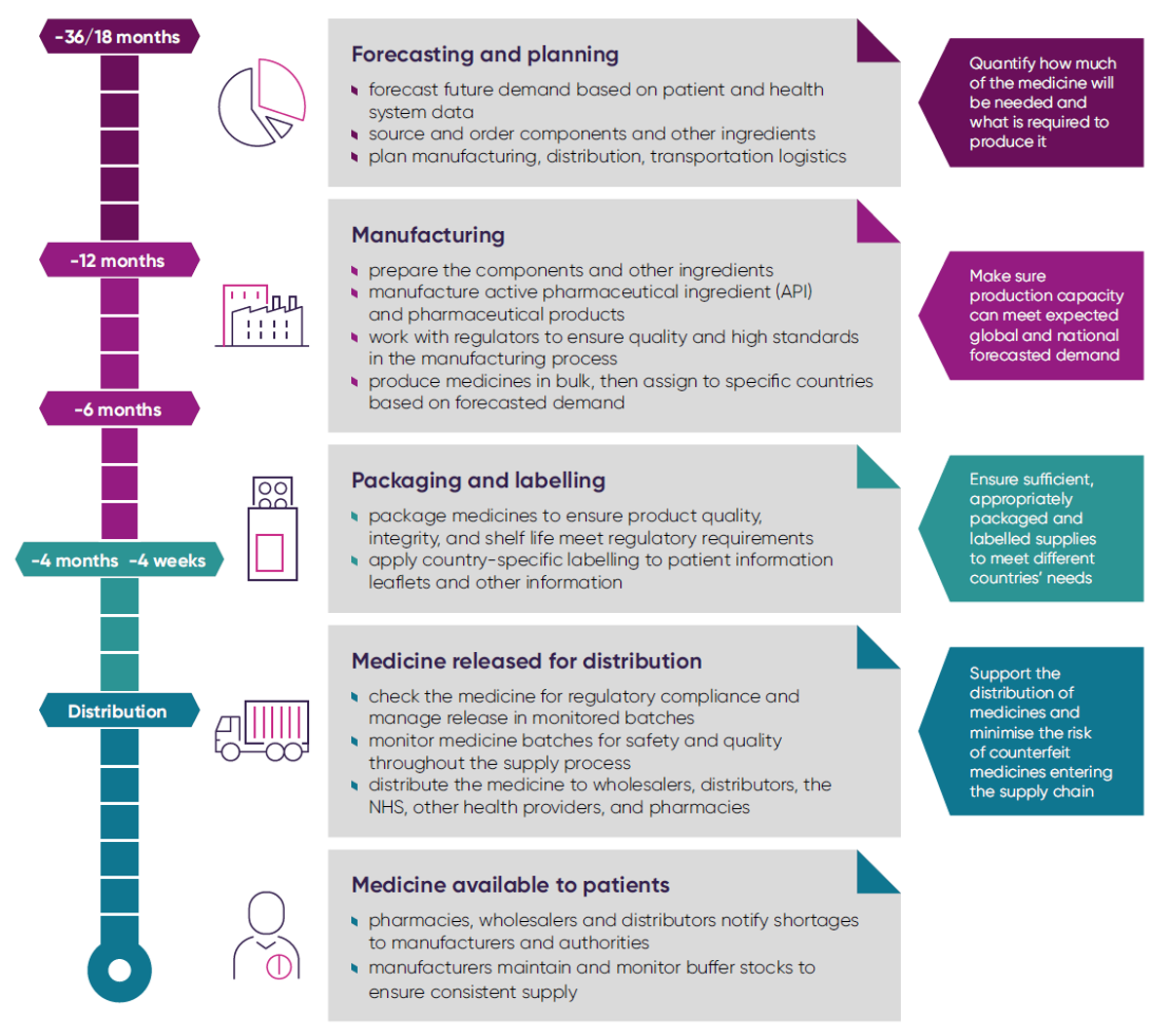
Key roles and responsibilities in the supply chain:
Medicines reach patients through a chain of organisations, each with a different role. When risks emerge, these partners share information quickly so action can be taken early.
Pharmaceutical companies (marketing authorisation holder): responsible for manufacturing/sourcing, meeting regulatory requirements and reporting supply risks early via the DHSC's DaSH portal.
DHSC: coordinates national response, assesses risk and can use emergency measures (for example, logistics support, Serious Shortage Protocols or other proportionate measures in extreme cases)
NHS: manages impact in the health system, supporting equitable distribution and guidance to services.
MHRA: enables continuity by fast-tracking regulatory actions (for example, alternative pharmaceutical companies/imports when necessary).
Wholesalers: distribute medicines nationally; often spot issues early and support pharmacies with alternatives
Community pharmacies and other providers: distribute medicines to patients and source alternatives if needed.
How do pharmaceutical companies plan?
One of the most important ways to keep medicines available is through accurate forecasting and careful planning. Manufacturing medicines takes time, often nine to eighteen months from start to finish, due to complex global supply chains. Pharmaceutical companies therefore must predict demand and prepare months in advance.
To do this, pharmaceutical companies use some of the most advanced planning systems in any industry. These tools help them to stay ahead by forecasting demand, tracking supply and responding early to potential problems.
| Integrated business plan | Sales & operations plan | Business continuity plan |
|---|---|---|
| A global long-range planning process, tracking finances, operations, and supply chain data | Matches demand forecasts with factory capacity and stock levels through regular team reviews | Emergency plans for disruptions, from factory breakdowns to wars |
Real-time monitoring:
Pharmaceutical companies don't just plan; to stay ahead they watch supply constantly using:
-
real-time stock reports from wholesalers
-
daily sales and usage monitoring including scripts
-
past sales data and usage trends
-
factory capacity and inventory tracking
-
coordination across different countries
-
statistical forecasting models
-
AI-powered forecasting models.
Can technology help us to improve forecasting?
Some pharmaceutical companies are using AI to strengthen medicines supply forecasting. For example, pharmaceutical companies are using AI-based models to improve predictions of medicine demand.
Developed by data analysts working closely with finance teams, these models are embedded directly into demand-planning systems. Markets can use the AI forecast as a starting point, adding local insight and market knowledge where needed. Use of these models is increasing, and improvements in forecast accuracy have been encouraging.
Elad Carol,
Head of Supply Chain and Customer Care UK at Novartis Pharmaceuticals UK Limited

We are moving towards a future where manual interventions and traditional statistical models are progressively augmented, and in some cases replaced, by advanced AI models."
This approach helps commercial, finance and supply chain teams work from a shared set of projections, giving the global supply chain clearer signals about what is needed and when. Ultimately, this supports stronger production planning, more reliable medicine supply and improved patient access.
The recent House of Lords Public Services Committee report also recommended that digital tools, particularly AI, barcodes and data analytics, play a critical role in improving forecasting accuracy and supply chain resilience. They urged further investment in technology to better predict demand and address supply disruptions.
Why forecasting is challenging:
Despite advanced tools, forecasting is not an exact science. Global events, sudden regulatory changes and shifts in prescribing behaviour can disrupt the most robust supply plans. Even with advanced systems, the main challenges include:
1. Parallel trade
Medicines bought and sold across borders create unpredictable demand patterns that can disrupt supply forecasts
2. Contract uncertainty
When contracts are awarded to supply medicines, pharmaceutical companies often receive limited notice to ramp up production with up to a year required to do so effectively
3. Generic medicines
Generic medicines (which make up 75 per cent of NHS prescriptions) have thin profit margins; pharmaceutical companies can enter or exit the market quickly, creating sudden gaps that are difficult to predict
4. Demand surges
Sudden spikes in demand, driven by social media (like GLP-1 weight-loss drugs or HRT), seasonal illnesses (like Strep A antibiotics) or cultural factors, can overwhelm supply; demand surges cause 20 per cent of all supply disruptions. When contracts are awarded to supply medicines, pharmaceutical companies often receive limited notice to ramp up production with up to a year required to do so effectively
Forecasting is a shared responsibility. While pharmaceutical companies forecast supply, the NHS should also provide timely and accurate demand signals where acute supply issues are likely to occur, to ensure alignment and avoid mismatches.
Why do disruptions happen?
Despite best efforts in planning and risk management, issues do arise. In fact, 80 per cent of pharmacy owners reported to Community Pharmacy England that their business experienced an increase in medicines supply chain/wholesaler issues in comparison to the previous year.
In a recent survey ABPI member companies reported that two common causes of disruptions are raw material shortages and forecasting and planning challenges. Understanding why supply chains can go wrong is crucial to preventing future problems. The following diagram sets out some of the local and global factors that can impact supply.
How is impact minimised?
Claire Foreman,
Director of Medicines Policy and Strategy for NHS England
When issues happen – and they do – having trusted relationships with industry partners and early, open conversations mean that we can come together quickly and work out what can be done collectively and collaboratively to do what's best for patients.
When an issue hits, speed matters. The faster everyone responds, the less likely patients are affected. The UK system relies on early collaboration between pharmaceutical companies, the NHS and government.
Factors that can cause supply disruption

What pharmaceutical companies do:
- Buffer stock: some secondary care NHS contracts require pharmaceutical companies to hold eight to twelve weeks of critical medicines stock. This helps prevent unexpected supply disruptions.
- Proactive communication: pharmaceutical companies must alert the DHSC as soon as possible via the DaSH portal if a problem emerges.
- Fair distribution: when supply runs short, all stakeholders work together wherever possible to distribute available stock fairly based on patient need, prevent stockpiling and manage regional supply imbalances.
- Global coordination: most issues are global. Pharmaceutical companies manage supply across countries, moving stock from where it's available to where it's needed most.
- Finding alternatives: when UK supply is disrupted, pharmaceutical companies may apply to the Medicines and Healthcare products Regulatory Agency (MHRA) to import medicines from other countries or fast-track supply from alternative pharmaceutical companies.
What the NHS and government do:
- National coordination: the DHSC Medicines Shortages Response Group (MSRG) brings together government, the NHS and industry to assess risks, agree actions and issue guidance to maintain patient access.
- Taskforces: for major disruptions, the DHSC sets up dedicated groups of pharmaceutical companies, pharmacists and regulators to coordinate action, share forecasts, monitor stock and speed up deliveries.
- Serious shortage protocols (SSPs): these give pharmacists emergency powers to dispense alternative approved products when the original is unavailable and limit prescriptions to one month's supply, so more patients get their medication.
- Example: during the 2023/24 HRT shortage, 23 SSPs were issued.
- Example: during the 2023/24 HRT shortage, 23 SSPs were issued.
- Medicine supply notifications (MSNs) in NHS England: MSNs tell doctors and pharmacists which medicines are short, what alternatives exist and when normal supply will resume.
- Example: the NHS issues around 130 MSN alerts every year.
- Example: the NHS issues around 130 MSN alerts every year.
- National Patient Safety Alerts (NatPSAs) – can be implemented to inform the NHS and healthcare providers of safety-critical risks that could cause serious harm or death and require urgent action to mitigate them
Examples of successful real-world collaborations
Using cultural insight to anticipate demand and keep medicines available
In 2023, a pharmaceutical company identified an unexpected increase in demand for norethisterone, a long-established, low-volume medicine. Early discussions with wholesale partners, supported by online research, revealed that demand rose during Ramadan, when some women use the medicine to delay menstruation so they can fast. This pattern recurred annually, reflecting the shifting Ramadan calendar.
The company adjusted its forecasting to ensure sufficient stock during Ramadan, looking several years ahead. From 2024, a wider seasonal trend also became apparent, with higher demand between March and August linked to similar short-term use around holidays and events.
Analysis of distributor sell-out data showed where demand was concentrated geographically and by customer type. This allowed stock to be targeted more effectively, including holding higher levels in areas with larger Muslim populations.
Together, these actions helped maintain availability during predictable peaks without disrupting wider supply.
Key takeaways
- Cultural and seasonal behaviours can drive predictable demand spikes.
- Early insight, forecasting and collaboration reduce disruption risk.
- Real-world data enables smarter stock placement.
Keeping a vital kidney transplant medicine available during a global shortage
In late 2023, a medicine used in kidney transplantation faced a global supply constraint. With no biosimilar and very limited alternatives, uninterrupted supply was critical to avoid patient harm.
As manufacturing output fell, the UK was placed under strict allocation. The pharmaceutical company worked with the MHRA and kept government health teams informed early, sharing visibility of risks, likely scenarios and key milestones.
When further manufacturing issues emerged, a joint task group was established with NHS procurement, government health officials and the pharmaceutical company. The group met regularly to track supply and agree actions. NHS procurement led hospital-level allocation decisions based on clinical need, government teams provided national oversight, and the company shared regular updates on volumes, timelines and distribution aligned to NHS guidance. This collaboration continued for around a year and helped manage demand fairly and consistently, avoiding patient impact despite ongoing global constraints.
Key takeaways
- Early coordination and transparency can prevent patient harm.
- Clear roles and shared governance support fair, needs-based access.
- Prolonged disruptions require sustained system-wide collaboration.
Impact on stock availability following a competitor stock-out
Patient access can be put at risk after loss of exclusivity when a lower-cost medicine enters the market but is unable to meet demand.
When a biosimilar launched, evidence suggested demand for the originator would fall sharply due to price differences. The original company reduced forecasts and reassigned manufacturing capacity, reflecting expectations across global markets.
Soon after launch, the biosimilar supplier experienced supply problems and could not meet demand or confirm recovery timelines. Prescribers increasingly returned to the originator medicine. With limited stock available, the original company had to rapidly increase production and imports, despite having already reduced capacity.
Although the company worked closely with Medicines Procurement and Supply Chain, NHS medicines supply teams and clinical homecare providers, information on the scale and duration of the shortage was limited and often anecdotal. This made it challenging for third parties to predict demand. Additionally, when competitors returned to stock, there was little visibility on demand in the UK, which made the situation even more complicated.
Unfortunately it is possible that the companies involved may not be utilising the DHSC's DaSH portal in a timely manner to report supply constraints, thus the manufacturer often only becomes aware of shortages after investigating a sudden spike in demand. The framework awards process further complicates forecasting, as unclear volumes make it challenging to plan ahead.
This lack of reliable data has made forecasting uncertain, forcing repeated trade-offs between shortage risk and potential overproduction. This situation has persisted for almost two years, placing sustained pressure on manufacturing plans and undermining confidence with global teams.
Key takeaways
- Loss of exclusivity can create new supply risks if market entry is not supply-ready.
- Limited data sharing during competitor shortages undermines effective response.
- Clearer accountability and planning at market entry are critical to resilience.
How a national response prevented a shortage of a life-saving stroke medicine
Alteplase is a potentially life-saving emergency medicine used in acute ischaemic stroke, heart attack and severe pulmonary embolism. For stroke patients, there is no alternative treatment, making access critical.
In 2022, rising global demand placed pressure on supply. The pharmaceutical company alerted the DHSC that disruption was likely to continue until manufacturing capacity increased.
The DHSC's Medicines Supply Team escalated the issue to the MSRG, prioritising use for the most life-threatening indications, particularly stroke thrombolysis. The DHSC worked with NHS England's national clinical directors to agree patient prioritisation and identify where alternatives could be used safely. Other thrombolytic manufacturers were also engaged.
The MSRG introduced a national allocation system to ensure fair distribution across the UK. NHS Pharmacy Procurement Specialists led this work with the company, supported by DHSC analysis to reduce waste through optimal vial sizing and dosing guidance.
Clear national communication, including patient safety alerts and targeted clinical guidance, helped prioritise use and minimise wastage. Through coordinated action, a complete stock-out was avoided and patients continued to receive alteplase where it was most critical.
Key takeaways
- Early collaboration and clinical input are essential in high-impact disruptions.
- Equitable allocation and waste reduction can prevent stock-outs.
- Clear, coordinated communication supports patient safety.
Recommendations for the future:

The medicines supply system generally works well, and most of the time patients are protected from disruption. But the risks are increasing. Supply chains are more global, manufacturing of some critical medicines is concentrated in very few countries, and geopolitical tensions are growing. That means we cannot be complacent. We need to put stronger mitigations in place now, rather than waiting for the next crisis.
In the past year, stakeholders from across the system have undertaken substantial work to improve resilience. This includes enhanced coordination through national supply groups, regulatory flexibilities and improved communication to frontline teams. These efforts are beginning to make a difference, but there is much more to do.
While the UK's supply chain is built on strong foundations of collaboration, patients and healthcare professionals are still impacted by issues. The following recommendations would help further improve medicine supply chains, ensuring patients continue to receive the medicines they need:
1. Improve the DaSH portal reporting system
The DaSH portal is a vital early-warning system for supply issues, but it does not allow enough detail to be input about disruption causes. This makes it harder to spot trends and issues in supply chains and to develop solutions.
Recommended actions:
-
Allow detailed reasons for disruptions to be recorded, enabling better trend analysis and identification of systemic issues.
-
Standardise categories to allow better comparison and analysis over time.
-
Require UK parallel importers to report disruptions into DaSH, improving visibility of demand and reducing unexpected issues caused by fluctuations in parallel trade supply.
-
Provide faster, more consistent feedback to pharmaceutical companies reporting via the portal, to strengthen the collaborative relationship between industry and government.
2. Enhance data sharing, forecasting and supply predictability
Better, earlier and more transparent sharing of information between the NHS, DHSC, industry and patients/patient groups would allow supply risks to be identified and mitigated sooner. Greater predictability around demand, procurement and policy change is essential to enable effective production planning, reduce disruption and protect patients.
Recommended actions:
-
Share anonymised market-share data (for example, volume levels, supplier categories) to improve forecasting and anticipate issues before they reach patients.
-
Collect and share data on whether medicines have one or multiple pharmaceutical companies supplying them, to identify where supply is most at risk.
-
Ensure timely information sharing between industry and the DHSC.
-
Put clearer processes in place for the NHS to share procurement forecasts with pharmaceutical companies earlier in the planning cycle.
-
Provide earlier visibility of policy, guideline or commissioning changes that are likely to affect demand, allowing sufficient time for production planning and scaling.
-
Conduct supply impact assessments before major national campaigns or expanded eligibility criteria that may trigger rapid increases in demand.
-
Align NHS procurement timelines more closely with manufacturing lead times, recognising that increasing production capacity can take nine to eighteen months.
-
Enable better digital connectivity across the system to streamline data flow and support more accurate, real-time forecasting.
3. Strengthen collaborative planning, communication and resilience
Earlier, more coordinated communication and longer-term planning across the whole sector – from national bodies to local providers and patients – would improve supply stability and reduce avoidable disruption. Embedding supply resilience into decision-making will support long-term sustainability.
Recommended actions:
-
Where supply issues occur, communicate earlier and more transparently across the sector and with patients, to prevent over-ordering and unnecessary waste.
-
Ensure requests to increase supply are realistic, take account of each supplier's usual market share and minimise the risk of over-production or market distortion.
-
Give as much notice as possible (ideally one year) for major NHS contract awards so pharmaceutical companies can safely plan and scale production.
-
Avoid awarding supply contracts based solely on the lowest price; incorporate supply reliability, resilience and continuity criteria into procurement weighting to incentivise long-term stability (value-based procurement).
-
Establish patient-focused supply roundtables, where appropriate, to improve shared understanding of risk and impact.
-
Increase communication and visibility across the sector to smooth supply and demand, for example, through improved portals or IT solutions that provide greater visibility of supply issues at GP and pharmacy level, supporting better prescribing decisions and reducing patient frustration.
-
Reduce duplicated reporting requirements across the UK by coordinating processes through the DHSC (where possible), freeing up NHS and industry resource to focus on proactive supply management.
4. Support innovation and digital transformation
Technology could significantly improve forecasting and coordination across the supply chain, but AI adoption is inconsistent and digital connectivity remains limited.
Recommended actions:
-
All industry stakeholders should consider appropriate use of AI or IT solutions to improve digital systems and streamline data flow to detect shortages earlier.
-
Government should encourage the use of proven industry-led AI or IT solutions to improve digital connectivity and speed up responses to disruptions.
-
Prioritise patient safety and system reliability when adopting new technology.
-
Share learnings and best practices across pharmaceutical companies to accelerate adoption.
-
Invest in digital infrastructure that provides real-time visibility across the supply chain, allowing more proactive management.
5. Enable regulatory flexibility
Regulatory constraints, like the UK-only pack rule, can delay access to alternative pharmaceutical companies during critical supply disruptions; greater flexibility would help reduce patient impact.
Recommended actions:
-
Allow regulatory flexibility so that certain EU packs can be supplied during shortages, avoiding delays as co-packing is slow.
-
Continue the MHRA's fast-tracking of regulatory approvals when shortages occur.
-
Review and simplify the processes for temporary imports during shortages.
-
Reduce unnecessary regulatory administrative burden while maintaining patient safety, freeing up time and resources for more strategic activities.
Methodology
ABPI member workshop:
A workshop was held on 19 November 2025 with ABPI Supply Chain Forum members to understand best practices, identify challenges and develop recommendations. The workshop covered topics such as supply chain management processes, dedicated roles, technology use, MAH responsibilities, misconceptions, collaboration mechanisms, challenges and case studies.
Participants:
Ross Maclagan, Head of Supply & Distribution Policy, ABPI
Kim Assender, Director of Commercial Policy & Analysis, ABPI
Ed Grunill, Client Partner, ZPB Associates
Taylor Lawrence, Senior Consultant, ZPB Associates
Isabella Archibald, Account Executive, ZPB Associates
Rebecca Webber, Commercial Operations Manager, Abbvie
Richard O'Toole, Commercial Partnerships & Supply Strategy, AstraZeneca
Helen Hamlin, Head of Supply Chain, Takeda
Emma Baker, Channel Engagement Lead EMEA & NA, Bayer
Elad Carol, Head of Supply Chain & Commercial Operations UK, Novartis
Martin Simmonds, Supply Chain Program Manager, Sanofi
Stakeholder interviews:
Interviews were conducted with a range of stakeholders from NHS England, the DHSC, the devolved nations and other relevant bodies. These structured conversations discussed current and future challenges and opportunities. Insights from these meetings have been included in aggregate.
Participants:
David Simmons, Director, Supply Resilience, DHSC
Dr Keith Ridge, Former Chief Pharmaceutical Officer for England, NHS England and DHSC
Lindsay McClure, Associate Director, Medicines Pricing & Supply at NHS National Services Scotland
Danny Palmer, Medicines Procurement Specialist, South West England, Bristol
Kate Mitchell, Senior Pharmacist at UK Department of Health
Ian King, Medicines Supply Team, DHSC
Claire Foreman, Director of Medicines Policy & Strategy at NHS England
Adam Anderson, Deputy Director Medicine Procurement & Supply Chain, Medicine Value & Access Directorate, NHS England
Zahir Rashid, Medicines Supply Chain & Medicines Resilience Programme lead (Senior Medicines Assurance Manager), NHS England
David Hutchings, National Medicines Value Unit Lead Pharmacist, NHS Wales Shared Services Partnership
Rhiannon Walter-Davies, Assistant Director of Medicines Procurement & Optimisation Wales, NHS Wales Shared Services Partnership
Martin Sawer, Executive Director, Healthcare Distribution Association UK (HDA UK)
John Preston, Director of Regulatory & Development, HDA UK
Jacob Lant, Chief Executive, National Voices
Elizabeth Hoda, Policy and Projects Officer, National Voices
Kenny Li, Chief Pharmacist, NHS Greater Manchester
Bruce Warner, Former Deputy Chief Pharmaceutical Officer, NHS England
Specialist pharmacy service (SPS) data analysis:
Analysis of the SPS dataset covering the period from 23 September 2024 to 3 November 2025.
-
Identified the earliest and latest dates medicines appeared in the dataset.
-
Calculated the duration from the earliest date to the earliest resolved date.
-
Analysed delays between the anticipated resupply date and actual resolution.
-
Examined the distribution of impact levels (low, medium, high, critical).
-
ThemeSupply
-
PublisherABPI
-
Last reviewed date01 June 2026
-
Next review date01 June 2031