-
ABPI Website

-
Partnerships
-
Patient involvement
-
Charity-Industry Partnership Case Study Library
- Partnering with parents to develop flu vaccine information
Partnering with parents to develop flu vaccine information

Patient organisations and company partners
AstraZeneca (AZ) and the Patient Information Forum (PIF)
Summary
Patient Information Forum (PIF) operates the PIF TICK trust mark for health information. The PIF TICK has 10 criteria to ensure information is evidence-based, involves users in production and is health-literacy friendly.
AstraZeneca achieved PIF TICK certification in October 2024. It applied its new information production process to information for the 2025 winter flu vaccine campaign. Involvement of parents transformed AstraZeneca’s annual flu campaign materials, resulting in a 6 times uplift in leaflet distribution to healthcare professionals (HCPs).
Project type
User engagement in disease awareness campaigns
Project focus
Ensuring children’s flu vaccines information meets the needs of parents
Finding the right partner
AZ and PIF had a pre-existing partnership which included health literacy training for staff. AZ started the PIF TICK assessment process in 2024.
Contracting and assessment
PIF TICK certified organisations pay an annual fee for assessment, certification and membership.
The aim of certification is the development of a robust and compliant health information production process. Teams then apply the process independently to produce trustworthy health information that meets the needs of their users.
As part of the certification process, AZ reviewed its health information production process with the support of the PIF assessment team. AZ created an internal process to ensure users were engaged in health information development and all outputs were health literacy friendly.
Implementation
AZ applied its new information production process to information for parents to support the winter flu vaccine campaign for 2-16 year-olds. AZ engaged with a diverse group of UK parents and conducted in-depth interviews to gain feedback on existing flu vaccine educational materials.
Key points of feedback included:
- The leaflets were too text heavy and included complex language.
- More ‘facts and data’, particularly about side effects, would support informed decision making.
- Some key facts were missing, including where to get the vaccine.
- Images of young children suggested that the vaccine was not for older children and teenagers.
- Use of white text on mid-blue background was difficult to read for people with visual impairment or neurodivergence.
- Stating the children’s flu vaccine programme was NHS-led, and adding trust marks, would help improve credibility.
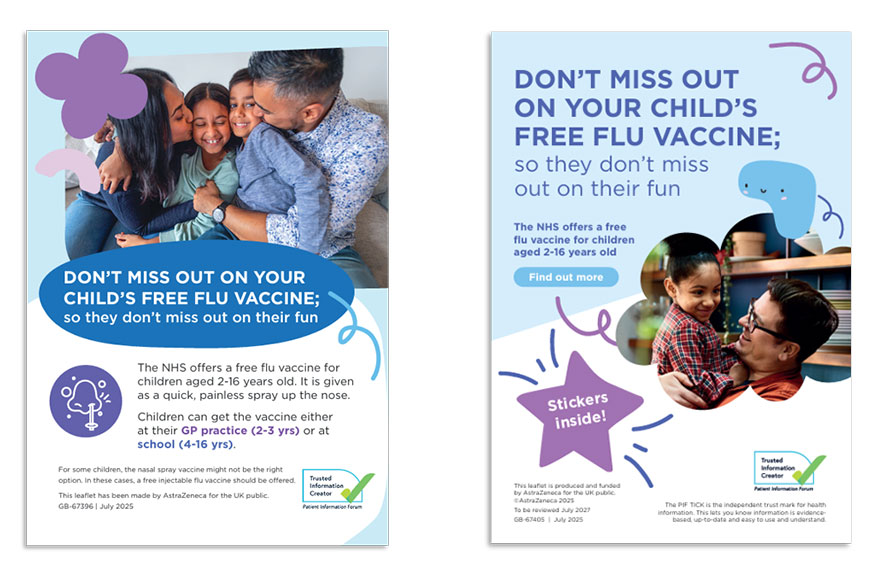
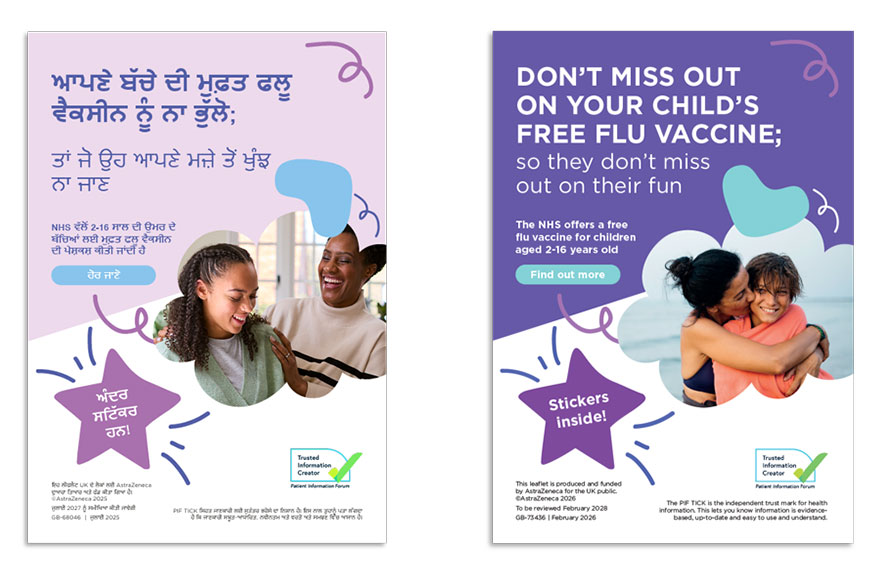
The parent leaflet was re-created for 2025. Key changes included:
- Reduced word count.
- Text reading age of 11 with difficult words explained.
- Additional information added on side effects and where to get a vaccination.
- Specific mention of the ‘NHS vaccination programme’ to increase credibility.
- PIF TICK logo added to the cover to increase trust.
- Younger child and older child versions produced to resonate with parents of all children and clarify eligibility.
- 12 translated versions and an Easy Read leaflet created.
- Brand colours maintained but adjusted to meet accessibility standards.
- Leaflets made available via ‘trusted sources’; GP and schools, as well as digital dissemination routes based on end user (parent) input.
Impact of the project
The new leaflets have been well received by parents and by the healthcare professionals who distribute them.
In particular, the added trust markers have increased HCPs’ motivation to share materials developed by a pharmaceutical company.
Providing multiple accessible versions has enabled HCPs to support parent education in areas of high diversity and deprivation, where vaccine uptake is typically low.
As a result of the changes, AstraZeneca distributed 67,700 leaflets during the 2025–26 season, almost six times the volume of the previous year.
Learnings from the engagement have been carried through into other areas. The brand book has been updated to meet accessibility standards and reflect more diverse imagery.
Insights from the user engagement have been fed into key message documents and used to inform other elements of the campaign, including social media posts.
Download copies of the PDF from Share Good Time Not Flu website. This link will take you to an AstraZeneca website developed for the general public in the UK.
“The PIF TICK criteria are designed to result in the production of evidence-based, health literacy friendly information. This excellent project really demonstrates the impact. Co-design helped shape the content, format and delivery of information. The result is a suite of information to meet the needs of all types of parents and carers on a topic surrounded by misinformation.” Sophie Randall, Director, PIF.
"As brand managers we are used to creating communications for healthcare professionals, it’s easy to forget parents come from all kinds of backgrounds and often have lower levels of health literacy than we expect. The process taught me that truly patient-facing materials need to be clear, accessible, and built around real people’s needs. I now use these principles in all our flu materials, and I’m proud that our approach is genuinely patient-focused. I’m also excited to work towards PIF certification on even more of our campaign going forward." Beth Daggett, Brand Manager, Vaccines & Immune Therapies
GB-74857 | March 2026
Last reviewed date: 07 April 2026
Next review date: 07 April 2029