Health Technology Assessment

Medicines Approval in Wales
- The Medicines and Healthcare products Regulatory Agency (MHRA) determines whether medicines are safe, effective, and licensed for use across the UK, while National Institute for Health and Care Excellence (NICE) assesses their clinical and cost-effectiveness to decide whether NHS Wales should routinely fund them. Further detail on the role of the MHRA and NICE assessments in the UK can be found here.
- If NICE recommends a medicine through it's Technology Assessment Guidance programme, it must be made available in Wales within 60 calendar days. This is supported by Welsh Government's New Treatment Fund.
- If a medicine has not been assessed by NICE (or has not been recommended by NICE), the All Wales Medicines Strategy Group (AWMSG) can provide Wales-specific guidance where there is a clearly identified clinical need or benefit to the NHS in Wales. This process is supported by the All Wales Therapeutics and Toxicology Centre (AWTTC).
All Wales Therapeutics and Toxicology Centre
AWTTC identifies licensed and off-label medicines that are likely to need assessment by the AWMSG.
AWTTC considers submissions from the pharmaceutical industry, healthcare professionals and patients, carers and the public.
More information about industry submissions can be found here.
The centre can also offer advice on all routes to access medicines in Wales.
All Wales Medicines Strategy Group
- The AWMSG consists of a multidisciplinary team, including NHS consultants, GPs, nurses, pharmacists, health economists, lay representatives, and ABPI members.
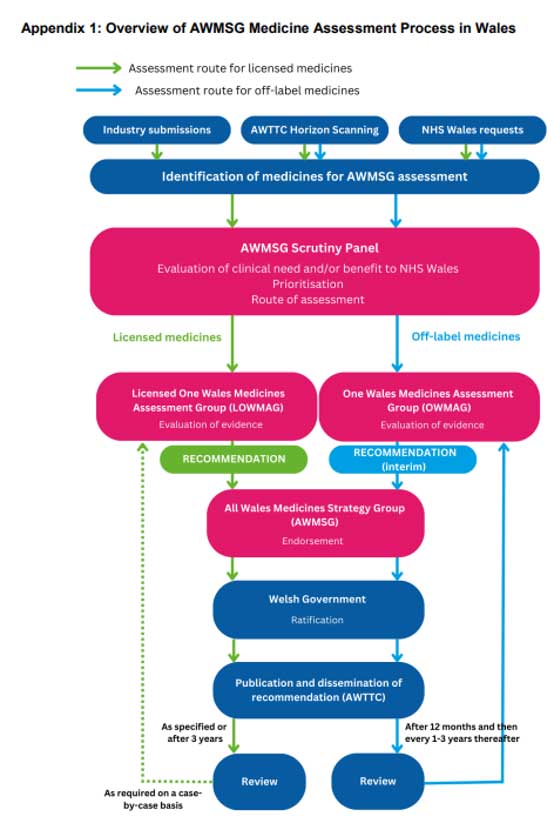
- Following identification of a potential medicine by AWTTC, evidence is provided to the AWMSG Scrutiny Panel for consideration. This panel is responsible for deciding if AWMSG should proceed with the assessment of a licensed or an off-label medicine.
- It is expected that most licensed medicines will process through HTA by NICE, and the AWMSG would not normally conduct an appraisal if NICE will appraise the medicine. However, when there is a clinical need or benefit to NHS Wales and a licensed medicine has not been prioritised or processed for HTA assessment by NICE, the AWMSG Scrutiny Panel will determine whether assessment is required.
- Once the panel decides if a medicine is suitable for assessment, the AWTTC will then request that the applicant company complete the appropriate submission form for the assessment to proceed.
- AWMSG has two subgroups which provide recommendations:
- Licensed One Wales Medicines Assessment Group (LOWMAG): provides recommendations to AWMSG on new and existing licensed medicines.
- One Wales Medicines Assessment Group (OWMAG): provides recommendations to AWMSG on off-label medicines as part of the One Wales Medicines Process.
- Recommendations from these groups are shared with AWMSG members, who are then asked to endorse these recommendations. These recommendations are then given to Welsh Government for ratification.
Submissions to AWMSG
- The AWMSG Scrutiny Panel will decide if a medicine is suitable for AWMSG assessment and the type of assessment required. AWTTC will then request that the applicant company complete the appropriate submission form for the assessment to proceed.
- There are two types of submissions:
- Full HTA submission.
- Limited submission where less information is required.
- The submission process for rare and severe diseases have additional requirements.
Types of AWMSG Assessment
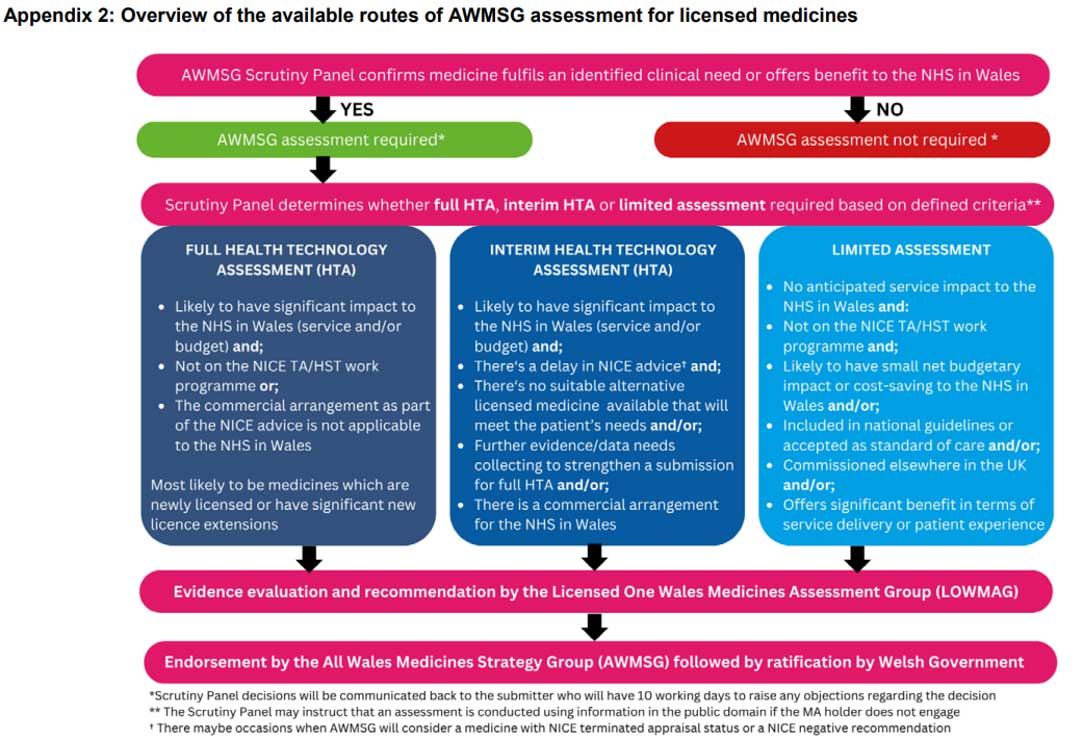
- The AWMSG scrutiny panel will decide whether advice on a medicine is needed in NHS Wales, and if so, which of the following three assessments is required for a licensed medicine:
Full Health Technology
Assessment (HTA)
- Likely to have significant impact to the NHS in Wales (service and/or budget) and;
- Not on the NICE TA/HST work programme or;
- The commercial arrangement as part of the NICE advice is not applicable to the NHS in Wales
Most likely to be medicines which are newly licensed or have significant new licence extensions
Interim Health Technology
Assessment (HTA)
- Likely to have significant impact to the NHS in Wales (service and/or budget) and;
- There's a delay in NICE advice† and;
- There's no suitable alternative licensed medicine available that will meet the patient's needs and/or;
- Further evidence/data needs collecting to strengthen a submission for full HTA and/or;
- There is a commercial arrangement for the NHS in Wales
Limited Assessment
- No anticipated service impact to the NHS in Wales and:
- Not on the NICE TA/HST work programme and;
- Likely to have small net budgetary impact or cost-saving to the NHS in Wales and/or;
- Included in national guidelines or accepted as standard of care and/or;
- Commissioned elsewhere in the UK and/or;
- Offers significant benefit in terms of service delivery or patient experience
- The assessment of an off-label medicine (or medicine combination) considers nationally agreed criteria, including the suitability of any licensed medicine for the same patient group, and evaluation of the clinical efficacy versus the clinical risk of off-label medicines that may help patients with life-threatening, long-lasting or seriously debilitating conditions.
Reasons for Limited Submission
- Potential reasons for a limited submission include the following circumstances:
- a significant new formulation which has a pro-rata or lower cost per treatment e.g., slow release, new chemical salt of established medicine.
- a license extension which is deemed minor by the AWMSG Steering Committee.
- if the anticipated usage in NHS Wales is considered by the AWMSG Steering Committee to be of minimal budgetary impact.
- if the estimated difference in cost compared with the appropriate comparator(s) is deemed by the AWMSG Steering Committee to be small.
- follow-on biologic medicines, i.e., a biologic product which is identical to an existing product (produced on the same production line in the same factory) but with a different product license.
AWMSG Approach to Paediatric Minor License Extensions
- AWMSG will not routinely appraise a medicine with a minor licence extension for the treatment of children and adolescents (aged up to 18 years), where the medicine is accepted for use by AWMSG or NICE for the same indication in the adult population.
- In these circumstances Health Boards should continue to add paediatric licence extensions to their formularies. This process aims to improve access to medicines for children, ensuring they can be made available as soon as is practically possible and aligns with NHS England and NHS Scotland.
- AWMSG will no longer expect to routinely receive a submission for a paediatric minor licence extension; however, should the need arise (such as inequity of access in Wales, or uncertainty in the evidence base), then AWMSG reserves the right to appraise a medicine where there is a clear clinical need.
AWMSG Approach to Very Rare and Severe Conditions
- Very Rare Disease:
- Companies can submit a medicine for assessment under the AWMSG “very rare diseases policy”, if it receives confirmation from the AWTTC that the medicine is eligible.
- The appraisal process for a medicine to treat a very rare disease aligns with AWMSG’s appraisal process for all other medicines, although a higher cost-effectiveness threshold will be considered, usually up to £100,000 per QALY gained. If a medicine offers significant QALY gains then additional weighting can be applied.
- However, if a negative recommendation is received from LOWMAG, the applicant company has the option to convene a Clinician and Patient Involvement Group (CAPIG) to further assess the benefits of the medicine from the perspective of clinicians and patients. Following a CAPIG meeting, LOWMAG will be asked to make a new decision which may uphold the original recommendation or overturn it. This recommendation is sent to AWMSG for endorsement.
- Severe Conditions
- AWMSG assessments for severe conditions will consider additional criteria when appraising medicines. Companies can request a severity modifier in their submission, that if granted will lead to a higher weighting being given to QALY gains in the assessment process.
UK Approach to Antimicrobial Medicines
- In 2024 the Antimicrobial Products Subscription Model was announced. Under this model, NHS England will pay a fixed annual subscription fee to a pharmaceutical company for access to new antibiotics. The pharmaceutical company receives a guaranteed return for access to its products, and there is no incentive to overuse (or over sell) these medicines.
- NICE will assess each medicines' eligibility for the scheme and its value to the NHS. This assessment will be used to place medicines in one of four bands, attracting subscription fees of between £5million and £20million per year for England. Access can also be extended to Scotland, Wales and/or Northern Ireland for an additional fee.
- The model fulfils a commitment in the UK's five-year plan (2024-2029) to address antimicrobial resistance. Contracts began on 1 April 2026.
AWMSG Approach to Biosimilars
- AWMSG does not usually appraise biosimilar medicines.
- Existing health technology assessment (HTA) advice for the ‘reference’ medicine, published by AWMSG or the National Institute for Health and Care Excellence (NICE), will automatically apply for biosimilar medicines licensed for the same indication and in the same population as the ‘reference’ medicine. Without advice for the ‘reference’ product, a biosimilar medicine is not endorsed for use within NHS Wales.
- In 2023 the AWMSG launched a national strategy for Wales to maximise the opportunity presented by biosimilar medicines, with a goal to support the conditions needed to create a strong, competitive biological and biosimilar medicines’ market.
AWMSG Approach to Cell and Gene Therapies
- AWMSG expect that the majority of cell therapies and gene therapies will be appraised by NICE.
- With the exception of those cell and gene therapies submitted for appraisal by NICE, AWMSG will appraise cell and gene therapies for patients living in Wales if the therapy has been classified as a medicinal product.
AWMSG Guidance
- Assessments make one of three recommendations:
- Recommended: medicine can be routinely prescribed to treat the disease assessed.
- Recommended with restrictions: medicine can be used in a smaller group of patients than stated in the medicine’s licence.
- Not recommended: medicine should not be routinely prescribed.
- After AWMSG endorsement, AWTTC sends the recommendation to Welsh Government for ratification. All new medicines that NICE or AWMSG recommend for use in the NHS must be available for prescribing to patients in Wales within 60 days of Welsh Government ratifying AWMSG’s guidance, or within 60 days of the date that NICE publishes its Final Appraisal or Final Evaluation Document. Funding is accessed using the Welsh Government New Treatment Fund.
- For medicines used off-label, health boards and NHS Wales Joint Commissioning Committee (NWJCC is a Joint Committee of the seven Health Boards acting collectively on their behalf) are expected to fund the medicine according to the ratified AWMSG recommendation.
Review
- AWTTC usually reviews positive (including positive with restrictions) recommendations for licensed medicines 3 years after publication. The review looks for any significant new evidence or information published that is likely to affect the current AWMSG advice. If any is found, further investigation or reassessment of the recommendation may be appropriate.
- OWMAG reviews all recommendations for off-label medicines 12 months after they are first published, and then every 1 to 3 years thereafter. The reviews consider any new evidence and patient outcome data (if available). After the review, OWMAG may decide to:
- renew the recommendation for up to 3 years;
- renew it with restrictions or amendments;
- discontinue or retire the recommendation; or
- fully re-assess the recommendation using newly available information.
- LOWMAG reviews recommendations as required on a case-by-case basis
Summary Infographics
Infographics extracted from AWMSG Medicines Assessment Process for Licensed and Off-label Medicines.
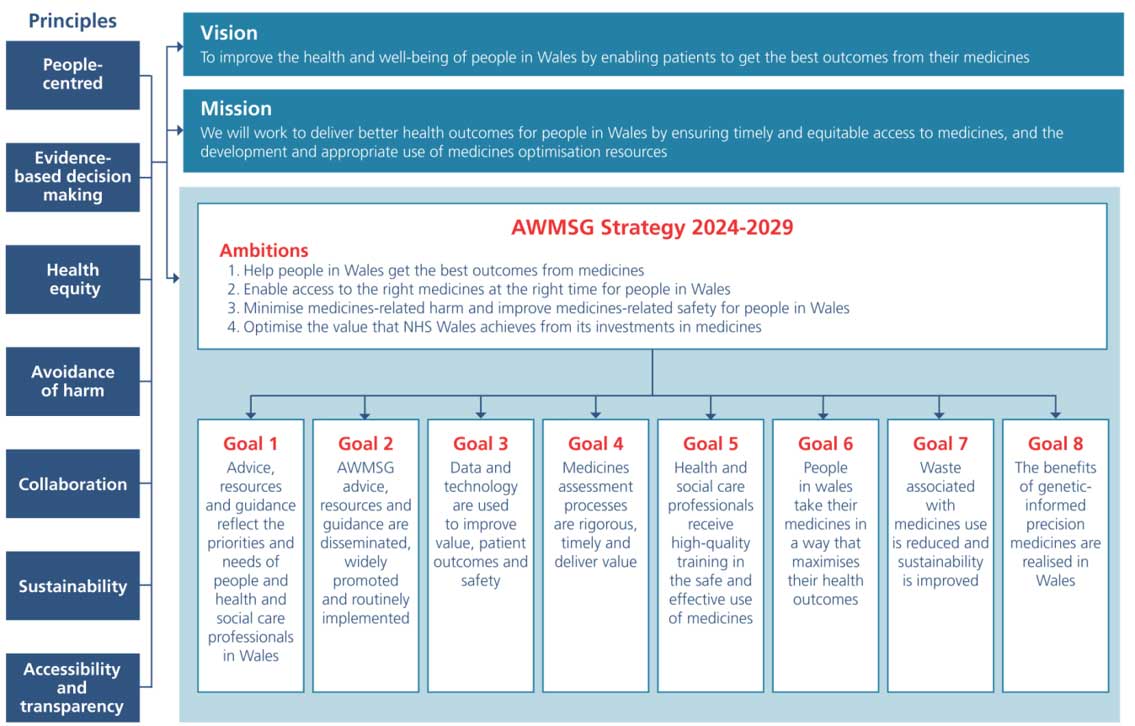
AWMSG Strategy for Wales: 2024-2029
- Insights for industry:
- Early and structured engagement: AWMSG places strong emphasis on horizon scanning and early dialogue, and companies that provide timely, high-quality information on their pipelines and implementation requirements are more likely to support efficient access.
- Broad definition of value: Assessments extend beyond clinical efficacy and cost-effectiveness to include real-world outcomes, patient benefit, safety, system impact, and sustainability considerations.
- Precision medicines require system readiness: While there is clear strategic support for precision medicines, successful adoption depends on robust planning for diagnostics, care pathways, workforce capacity, and commissioning arrangements.
- Collaboration and patient focus: Pharmaceutical companies are expected to engage constructively with patients, clinicians, and NHS Wales partners, aligning submissions and evidence with principles of equity, prudent healthcare, and long-term sustainability.
- Early and structured engagement: AWMSG places strong emphasis on horizon scanning and early dialogue, and companies that provide timely, high-quality information on their pipelines and implementation requirements are more likely to support efficient access.
AWTTC Work Programme 2025-2028
- The AWTTC Work Programme 2025-2028 outlines strategic objectives aimed at enhancing medicine access, optimisation, and data utilisation in Wales. The work programme brings together priorities identified with our partner organisations, work being delivered as part of the Voluntary Scheme for Medicines Pricing, Access, and Growth (VPAG) Investment Programme, and many of the goals identified in the AWMSG Strategy for Wales: 2024-2029.
- The programme focuses on:
- improved medicine horizon scanning and financial forecasting.
- continued development of the medicines access ecosystem and our processes for assessing medicines.
- new and improved processes that support the implementation of new medicines.
- improved sharing and utilisation of medicines-related data.
- continued development of high-quality medicines optimisation resources.
- enhanced health economic assessment to support all of AWTTC’s outputs.
- In total there are 22 objectives to support these focus areas.
Last reviewed date: 10 November 2026
Next review date: 10 November 2029