-
ABPI Website

-
Partnerships
-
Patient involvement
-
Charity-Industry Partnership Case Study Library
- Taskforce for Lung Health and Industries Forum
Taskforce for Lung Health and Industries Forum

Patient organisations and company partners
The Taskforce for Lung Health represents more than 50 organisations.
Summary
Members include national charities, professional bodies, medical royal colleges, patients and the ABPI. Asthma&Lung UK holds the secretariat for the taskforce. The linked Industries Forum represents commercial partners, including more than 10 pharmaceutical companies. The full member list is available on the website.
Project type
Multi-stakeholder coalition for policy change.
Project focus
The Taskforce has set a moonshot goal to reduce premature respiratory mortality by 25% and halve the deprivation gap by 2036.
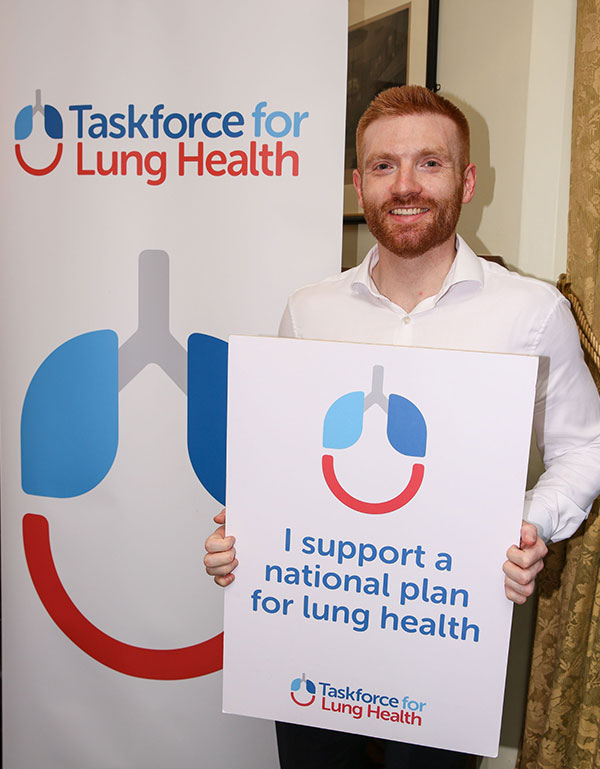
Danny Beales (MP for Uxbridge and South Ruislip) at the parliamentary launch event of the Taskforce's Breathing Life into NHS report.
Project overview
The Taskforce was established in 2018 with a mission to improve the nation’s lung health. Respiratory conditions affect around one in six people in England and are the third leading cause of death. The Taskforce has long campaigned for a national plan for lung health. In November 2025, it issued a call for a respiratory Modern Service Framework (MSF) in its Taskforce for Lung Health Consensus Statement. The campaign for a respiratory MSF has continued with its most recent publication, Breathing Life into the NHS, launched in July 2026.
The Taskforce demonstrates the power of consistent, cross-sector partnership to influence health policy over the long term. The associated Industries Forum has allowed for consistent partnership support, ensuring sustainability and independence for the Taskforce and an equal voice for all industry partners.
In its role as secretariat, Asthma&Lung UK, has provided a single channel for partnership, providing a compliant and consistent approach for industry and removing duplication of effort for charitable partners.
Finding the right partner
In 2017, the then British Lung Foundation (BLF) saw gaps in the effectiveness of lobbying and policy work across the respiratory sector.
The need for a co-ordinated lobbying effort to effect change was the driver to create a respiratory alliance that became the Taskforce for Lung Health. The ‘North star’ objective for the alliance was making respiratory health a national priority.
Following the merger with Asthma UK in 2020, Asthma&Lung UK took on the secretariat for the Taskforce.
Each year, the secretariat works with members to agree priorities for the next year to inform the funding application.
The funding model allows large and small companies to contribute to the work of the Taskforce, although membership of the Industries Forum is not dependent on providing a specific level of funding.
Recent funded projects have included an extensive lived experience research project and the development of a case for an NHS Respiratory Modern Service Framework.
The Industries Forum has no editorial control over Taskforce outputs. Maintaining the independence of the Taskforce and its outputs is vital to maintain credibility.
The original drivers for the creation of the Taskforce remain true today. In a crowded stakeholder landscape, where policymakers are not always thinking in single condition areas, the Taskforce brings together the capacity and capability of patients, professionals and industry to make a strong case for improvements across lung health.
Scoping and contracting
Interested industry partners are able to engage with the Industries Forum via the secretariat based within Asthma&Lung UK.
The Taskforce sets the scope of project funding required and the secretariat submits all grant funding applications on behalf of the Taskforce.
This creates a single point of contact for industry and allows the secretariat to utilise the corporate engagement expertise within Asthma&Lung UK. It is a successful model for multi-partner funding.
A funding statement is prominently displayed on the Taskforce website. It reads: ‘The Taskforce for Lung Health receives payments via arms-length agreements from both pharmaceutical and med-tech companies, which helps support our work. Contributing companies have no editorial control over the Taskforce’s activities, decisions, or publications.’
Funders for 2025 and 2026 are listed on the same page.
Implementation
The Taskforce's work is divided into two main topics; access to treatments and vaccines, and diagnosis. The work of both groups is reflected in the Breathing Life into the NHS report issued by the Taskforce in July 2026.
It calls for the Government to commit to the development and implementation of an NHS respiratory Modern Service Framework (MSF), underpinned by a focused co-design process with commitment from ministers and policy officials to deliver the policy, investment and system levers needed for a respiratory MSF to succeed. The report was launched at a parliamentary reception held in July 2026.
During the launch event more than 20 parliamentarians heard patients and professionals describe the importance of an MSF. The build up to publication saw targeted media comment pieces from the Taskforce chair, a comprehensive stakeholder briefing exercise, and political support demonstrated through more than 70 parliamentary questions being tabled.
Beyond the specific recommendations in the report, its publication also sent a message to decision makers: through the work of the Taskforce, there is an aligned respiratory sector, ready and able to work with officials to develop a plan to raise standards of care across England.
Impact of the project
Through its consensus-based and consistent lobbying the Taskforce has had notable successes. Respiratory health has been a key priority in successive NHS plans and a key target for health inequality.
Other achievements include, but are not limited to:
Engaging with all 42 Integrated Care Systems (ICSs) to ensure respiratory health remains a top priority in every region.
Establishing and commissioning the Taskforce data dashboards, giving healthcare professionals, commissioners and service planners access to detailed data on a range of respiratory measures.
Commissioning research by Imperial College London to improve patient pathways for lung conditions.
Development of an NHS Adult Breathlessness Pathway
Revised asthma guidelines
Introduction of Targeted Lung Health Checks.
Closing out the project
The project is ongoing. It is a strong and enduring coalition whose effectiveness comes from strong member and industry relationships, coordinated action, and sustained focus on raising lung health up the priority list.
The Taskforce has set a moonshot goal to reduce premature respiratory mortality by 25% and halve the deprivation gap by 2036. Sustained, system-wide partnership will be required to achieve this. And the Taskforce will be central to it.
Key learnings
The power of the Taskforce comes from aligning the insights and expertise of all involved. For that reason, it is also the aspect of the Taskforce that demands the greatest effort.
The patients, charities, health care professionals and life sciences organisations involved in the Taskforce are willing to look beyond their specific organisational goals, and work together on the bigger objective of ensuring policymakers prioritise lung health. That isn’t always easy, but it is at the core of its success.
That willingness to collaborate on cross-cutting issues, and to present a united voice, means that all involved can bring their combined resource to help drive change. It also sends a powerful message to decision-makers that the respiratory sector is aligned, and there is a ready-made mechanism for collaborating with the key bodies focused on improving lung health.
This collaboration and coordination comes with useful added benefits, including creating spaces for discussion amongst the patients, charities, professionals and industry that may otherwise not have taken place.
To anyone else thinking of emulating the success of the Taskforce, the three takeaways would be:
Put time and effort into building and sustaining relationships.
There is strength in long-term sustained partnerships.
Good things can be achieved when organisations are willing to think beyond their immediate priorities and collaborate for wider improvements.
Last reviewed date: 16 September 2026
Next review date: 16 September 2029