Disclosure UK 2025: the 11th year of Disclosure UK data, with industry transparency continuing to grow
Dr Amit Aggarwal, ABPI Executive Director of Medical Affairs and Strategic Partnerships, and Alex Fell, PMCPA Chief Executive, discuss the latest data published on Disclosure UK, the industry database which records payments and benefits in kind from pharmaceutical companies to NHS and other healthcare organisations and healthcare professionals.
Read Alex Fell’s blog: Package deals in the pharmaceutical industry and Disclosure UK data.
Each year, the publication of the latest Disclosure UK data provides us with another opportunity to analyse and understand the latest trends in how the pharmaceutical industry is working with healthcare professionals and organisations across the UK to improve patient outcomes and further innovation and research.
This year's data shows increased spend overall, and continued progress towards greater transparency.
For more detail on what Disclosure UK is, watch our handy video. [1]
Total transfers of value
This year’s Disclosure UK data show that total transfers of value (payments and benefits in kind from the pharmaceutical industry to healthcare professionals and organisations) in 2025 reached £929.6 million, an increase of 14.3 per cent on the £813.3 million disclosed for 2024. The figure for 2023 was £692.5 million. [2]
In two years, the total has grown by £237.1 million. That figure captures significant increases in both research and development (R&D) spending and non-R&D spending, and it deserves examination.
R&D growth
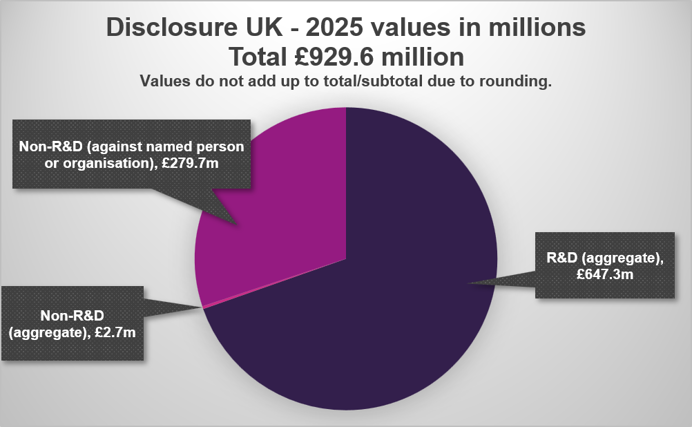
The key driver of spending growth in 2025 was research and development. R&D accounts for 70 per cent of all disclosed transfers of value on Disclosure UK, with spending increasing by 16.8 per cent from £554.0 million in 2024 to £647.3 million in 2025. The 2023 figure was £467.0 million. [3]
The reasons for the increase are likely to be multi-factorial and need to be read in context. R&D data in Disclosure UK also represents a relatively small portion (less than 10%) of pharmaceutical industry R&D investment in the UK. Therefore, further analysis will be needed to ascertain the true picture behind and interpretation of this increase.
Changes in other value categories
Non-R&D transfers of value also grew, rising 8.9 per cent from £259.2 million in 2024 to £282.3 million in 2025 (compared with £225.5 million in 2023). However, there is some evidence that this was partly driven by changes in regulatory guidance rather than changes in sector working patterns.
A non-R&D transfer of value is one that is unrelated to research and development activities, such as commercial, non-commercial, educational, or advisory activities. They may include donations and grants, sponsorship contributions to events such as conferences, fees for services including consultancy, advisory boards, and speaking engagements, and reimbursement of associated travel and accommodation expenses. [4]
Fees for contracted services
The main driver of the increase in non-R&D transfers of value was fees for contracted services to organisations, which account for just over 14 per cent of the total, the largest single non-R&D category. Healthcare organisations may be contracted as consultants and advisors, whether in groups or individually, for services such as speaking at and chairing meetings, involvement in medical or scientific studies, training on the use of a medicine, or participation in advisory board meetings. Third-party homecare providers will also be included in this category. Find out more here.
The increase in contracted services spend reporting may in part be driven by a recent update from the ABPI Code regulator, which aimed to provide greater clarity on a particularly complex area of disclosure reporting. Alex Fell, writes about the PMCPA's new guidance on ‘package deals’, published in January 2026. As companies work through the implications of that guidance, we may see further movement in this category in future years.
Fees for contracted services have increased by almost a quarter (24.4 per cent) from £107.9 million in 2024, to £134.2 million in 2025. The majority of the increase appears to come from payments to third-party homecare service providers, which may in part be because of the PMCPA’s package deal guidance published earlier in the year, as well as actual increases in homecare services activity. [5]
Company contributions to the cost of events increased by 15 per cent from £67.4 million in 2024 to £77.5 million in 2025. This may also in part be a result of the new PMCPA package deals guidance. By contrast, collaborative working fell from £22.1 million (2.74 per cent of total values) in 2024 to £14.5 million (1.6 per cent) in 2025. Donations and grants to healthcare organisations also decreased, from £56.7 million in 2024 to £50.7 million in 2025.
Transparency data for 2025
Disclosing via Disclosure UK is mandatory for all ABPI member companies and non-member companies signed up to the ABPI Code of Practice; a total of 150 companies disclosed values for 2025. [6]
Of those, ABPI member companies - which tend to be the largest and most research-active companies - account for the vast majority (94%) of 2025 activity, disclosing £871.5 million in total ToV (£262.4 million non-R&D), compared with £58.1 million (£20.0 million non-R&D) from non-member companies. Indeed, the top 10 highest-paying companies are all ABPI members and account for 61.7 per cent of the total transfers of value across all 150 disclosing companies combined.
The estimated proportion of named healthcare professionals against non-R&D transfers of value has reached 93.6 per cent, up from 91.9 per cent in 2024 and 80.8 per cent in 2023. [7]
Significantly for 2025, 95.1 per cent of the non-R&D value that healthcare professionals receive is disclosed against a named individual. The estimated number of healthcare professionals receiving non-R&D transfers of value has also increased year on year, with the top three professional areas by value being oncology, nursing, and haematology.
Patient Safety Commissioner Professor Henrietta Hughes is clear on the importance of transparency in the relationships between industry and the NHS.
Patient Safety Commissioner Professor Henrietta Hughes said: Transparency is at the heart of patient safety, and Disclosure UK is an important part of making the relationships between the pharmaceutical industry and healthcare professionals visible and accountable to the public. It's encouraging to see industry's continued commitment to this process. But transparency is a journey, not a destination - there is more to do to ensure these relationships are open to scrutiny, and I look forward to working with the ABPI and government on the new guidance to drive that forward."
The increasing estimated proportion of named healthcare professionals in non-R&D demonstrates remarkable progress. When Disclosure UK launched in 2016 with 2015 data, fewer than six in ten healthcare professionals agreed to be named. The consistent improvement is the result of sustained advocacy from the ABPI, professional bodies such as the Academy of Medical Royal Colleges, NHS England, and many others, alongside a growing number of companies adopting Legitimate Interests as their lawful basis for data processing under GDPR.
We have been pleased to see these numbers steadily increase over time, as historically, it has been seen as a key benchmark for transparency. However, it is important to recognise that a minority of healthcare professionals may have legitimate reasons not to be named on the database. Where objections are raised, companies will comply with UK data protection laws to uphold those individual's rights.
Conclusion
The 2025 Disclosure UK data tells a mixed picture in many respects. Expenditure associated with R&D is up, spend on collaborative working is down, and the level of transparency in non-R&D categories continues to grow. While further analysis and examination of longer-term data is needed to understand these trends better the industry's commitment to openness is steadfast and clear.
Summary of Disclosure UK data for 2025
- Total disclosed value, including R&D and non-R&D, increased by 14.3 per cent to £929.6 million, from £813.3 million in 2024, and £692.5 million in 2023.
- Total R&D value was £647.3 million, up from £554.0 million in 2024, and £467.0 million in 2023. The percentage split of R&D vs non-R&D remains similar.
- Total non-R&D value was £282.3 million in 2025, up from £259.2 million in 2024, and £225.5 million in 2023. This value increase is mostly attributed to payments to organisations. The number of activities with healthcare professionals has also increased, but not the average amount paid per HCP.
- Of the total non-R&D value, 99 per cent is published against a named person or organisation, which is higher than the 98.5 per cent for 2024, and 95.8 per cent for 2023.
- The estimated percentage of healthcare professionals named against non-R&D values has increased to 93.6 per cent for 2025, from 91.9 per cent for 2024, and 80.8 per cent for 2023.
- More than 60 companies used the lawful basis of Legitimate Interests to publish information about healthcare professionals.
- Collaborative working between industry and the NHS has decreased - with £14.5 million invested by companies in 2025, down from £22.1 million and £24.9 million in 2024 and 2023 respectively. See the ABPI’s library of 300+ partnerships in action.
- Values for contracted services (fees and expenses) increased in 2025 to £139.6 million from £113.0 million in 2024, and £91.2 million in 2023. The majority of the increase in 2025 compared with 2024 is attributed to a greater number of fees for contracted service reported to organisations, specifically third-party service providers. (Contracted service fees make up the £134.2 million reported; the remaining £5.4 million are related expenses.)
References
[1] Disclosure UK is the public, searchable database publishing ‘transfers of value’ (payments and benefits in kind) from pharmaceutical companies to UK healthcare professionals and organisations. It is part of pharmaceutical industry transparency requirements across Europe. You can find the Disclosure UK database and other resources at www.disclosureuk.org.uk.
Transfers of value disclosed via Disclosure UK include both direct or indirect payments, and benefits-in-kind, for example the value of a train ticket or accommodation.
[2] The 2025 healthcare professional (HCP)/healthcare organisation (HCO) data can be broken down as illustrated in the following chart:
|
Presenting results based on 2025 data as of 18 June 2026, 2024 data as of 17 June 2025, and 2023 data as of 19 June 2024 to allow time for analysis. Numbers can be updated over time. |
||||
|
Total categories |
2023 value |
2024 value |
2025 value |
|
|
What was the total transfer of value disclosed? |
£692.5 million |
£813.3 million |
£929.6 million |
|
|
How much did the industry spend on R&D activities with HCPs and HCOs? |
£467.0 million |
£554.0 million |
£647.3 million |
|
|
What percentage change was there in R&D spend vs. the previous year? |
+6.0% |
+18.6% |
+16.8% |
|
|
How much was spent on HCPs and HCOs for non-R&D activities? |
£225.5 million |
£259.2 million |
£282.3 million |
|
|
How much of the non-R&D value was against a named person or organisation? |
£216.0 million |
£255.4 million |
£279.7 million |
|
|
What percentage of the total non-R&D value is disclosed against a named person or organisation? |
95.8% |
98.5% |
99.1% |
|
|
Estimated percentage of named HCPs in non-R&D values |
80.8% |
91.9% |
93.6% |
|
|
Percentage of non-R&D values to healthcare professionals against named healthcare professionals |
81.4% |
92.9% |
95.1% |
|
|
Amount spent on the following for non-R&D activities: |
|
|||
|
£3.3 million |
£3.5 million |
£3.2 million |
|
|
£46.5 million |
£54.1 million |
£64.3 million |
|
|
£8.3 million |
£9.8 million |
£10.0 million |
|
|
£51.3 million |
£56.7 million |
£50.7 million |
|
|
£86.4 million |
£107.9 million |
£134.2 million |
|
|
£4.7million |
£5.1 million |
£5.4 million |
|
|
£24.9 million |
£22.1 million |
£14.5 million |
|
|
How many pharmaceutical companies disclosed data? |
143 |
151 |
150 |
|
[3] Values for research and development (R&D) are always published in aggregate and include transfers of value to healthcare professionals or healthcare organisations related to the planning or conduct of:
- non-clinical studies (as defined in the OECD Principles of Good Laboratory Practice)
- clinical trials (as defined in Regulation 536/2014)
- non-interventional studies that are prospective in nature and involve the collection of data from, or on behalf of, individual or groups of healthcare professionals specifically for the study
- costs that are subsidiary to these activities are also included.
[4] Values for non-R&D activities are broken-down and published against individually named healthcare professionals where data protection law allows, or healthcare organisations. These activities include:
- Registration fees – e.g., a company paying for an HCP to attend a medical conference for education and training.
- Sponsorship agreements with HCOs – e.g., a company may fund an independent organisation to run a training seminar.
- Travel and accommodation – e.g., paying for the accommodation or rail fares for an HCP to attend a conference.
- Donations and grants to HCOs – e.g., buying equipment for HCOs, such as medical equipment or, books, or providing funds which support disaster relief.
- Contracted services: Fees – e.g., paying HCPs for their time to sit on advisory boards and help with the development of medicines.
- Contracted services: Related expenses – e.g., travel and accommodation requirements to support an HCP to deliver the work they were contracted to do for a pharmaceutical company.
- Collaborative working – which refers to pharmaceutical companies working with other organisations to deliver initiatives which either enhance patient care or are for the benefit of patients or alternatively benefit the NHS and, as a minimum, maintain patient care.
- More information in How we work with HCPs and How we work with HCOs.
[5] Number of patients receiving homecare, figures from the National Clinical Homecare Association (NCHA):
- As at 31st Dec 2023 - 639,000
- As at 31st Dec 2024 - 685,000
- As at 31st Dec 2025 - 728,000 (estimated)
[6] The number of disclosing companies per year can fluctuate due to mergers or acquisitions, starting or ending relevant UK activity, or new companies formally complying with the ABPI Code of Practice.
[7] The percentage of named individuals is related to the lawful basis a company uses to process healthcare professionals’ data under the GDPR. For example, if a company is using ‘Consent’ as the lawful basis, but permission is withheld by the healthcare professional, the value can only be published in aggregate (not against a named person) on Disclosure UK.
The percentage rate of named healthcare professionals can only be estimated. Many healthcare professionals work with multiple companies so the same individual could appear in multiple companies’ aggregate data. A formula is applied taking into account an estimate of duplicates to give the estimated overall named HCP rate. Our data analysts use the same formula each year for consistency.
Disclosure UK is part of a European-wide transparency requirement for the pharmaceutical industry administered by EFPIA. European-level requirements are that R&D is disclosed in aggregate. There are various challenges to breaking down this data further, including that many R&D payments are blinded, issues with confidentiality agreements, challenges for companies reporting differently across multiple countries, and adding more red tape to R&D activities at a challenging time for UK clinical trials.
Last reviewed date: 30 June 2026
Next review date: 30 June 2029